
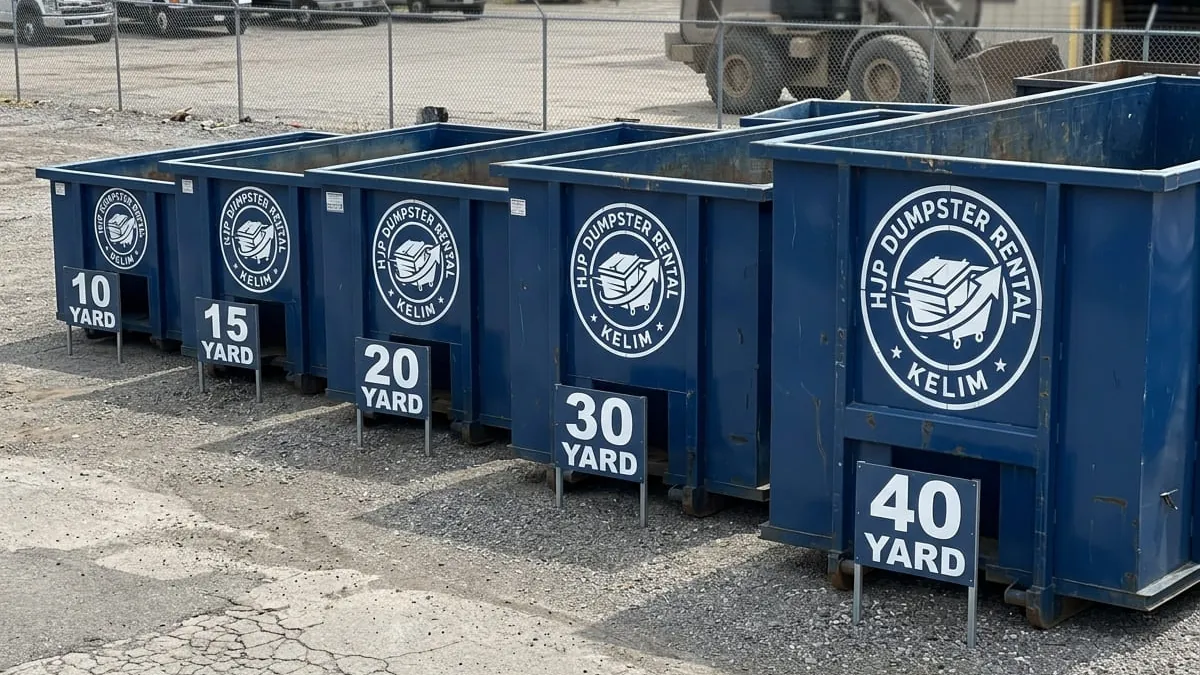
Compare all five sizes
Dumpster Sizes in Kelim, CO — 10, 15, 20, 30 & 40 Yard
Five roll-off sizes, and the honest version of which one you actually need. Two things decide it here: what the debris weighs — broken concrete, block, brick, mortar, spoil out of a 30-inch footing trench and a hail tear-off counted in squares and layers all run heavier than they look — and what the container is standing on, because on a soft gravel approach or a long drive down to a basement walkout the surface decides where a box can be set long before volume does.
All sizes
Pick by weight first, volume second
Scroll the table on mobile. If your load includes concrete, block, brick, mortar, footing spoil, tile set in a bed or shingle off a hail-damaged roof, start at the 10 or the 15 no matter how big the job looks — weight fills those long before volume does. Sizing charts written for somewhere else miss three things about this corridor. The first is the anchor job. Northeastern Colorado averages seven to nine hail days a year inside what NOAA calls the nation’s most hail-prone corridor, so roof tear-off is what this market buys containers for, and shingle is dense: it reaches lawful payload while the box still looks half empty, which is why roofing never goes in a 30 or a 40 here. The second is the ground. Both Weld and Larimer counties publish a 30-inch frost line, so footings and services start deeper, trenches produce more spoil, and basements are ordinary — the usual residential job is a basement and a garage cleared in the same fortnight rather than one room, which is a volume job and the reason the 20 yard leaves our yard more often than every other size put together. The third is that the driveway is the surface, not the lawn: several tons on four small contact patches will rut soft ground and then sit in the rut, so mats go under the wheels and both rails on every placement. And one jurisdictional note that decides more than sizing ever does — Kelim is in Larimer County, Johnstown sits in both Larimer and Weld, and five of the towns we serve straddle a county line, so tell us the address and we will tell you whose desk answers.
| Size | Capacity | Footprint | Weight allowance | Holds about | Best for |
|---|---|---|---|---|---|
| 10 Yard Dumpster | 10 yd³ | 12 ft x 8 ft x 3.5 ft | 2 – 3 tons | ~3 pickup truck loads | Broken slab, block, brick and dirt — the box that reaches payload long before it looks full. |
| 15 Yard Dumpster | 15 yd³ | 16 ft x 8 ft x 4 ft | 2 – 3 tons | ~4 – 5 pickup truck loads | The workhorse for an ordinary single-layer hail tear-off, or one room cleared to the walls. |
| 20 Yard Dumpster | 20 yd³ | 22 ft x 8 ft x 4.5 ft | 3 – 4 tons | ~6 – 8 pickup truck loads | A whole-house declutter — the default here — a large roof, or a multi-room remodel. |
| 30 Yard Dumpster | 30 yd³ | 22 ft x 8 ft x 6 ft | 4 – 5 tons | ~9 – 12 pickup truck loads | A large remodel, a basement strip-out or a full estate cleanout. Never roofing. |
| 40 Yard Dumpster | 40 yd³ | 22 ft x 8 ft x 8 ft | 5 – 6 tons | ~12 – 16 pickup truck loads | Commercial gut jobs and construction — it needs the most room to set down. |
10 Yard Dumpster
Broken slab, block, brick and dirt — the box that reaches payload long before it looks full.
View this size → 15yd³15 Yard Dumpster
The workhorse for an ordinary single-layer hail tear-off, or one room cleared to the walls.
View this size → 20yd³20 Yard Dumpster
A whole-house declutter — the default here — a large roof, or a multi-room remodel.
View this size → 30yd³30 Yard Dumpster
A large remodel, a basement strip-out or a full estate cleanout. Never roofing.
View this size → 40yd³40 Yard Dumpster
Commercial gut jobs and construction — it needs the most room to set down.
View this size →The two rules that decide it here
Weight beats volume on dense material, and the surface under the wheels beats both
This is the single most useful thing on the page. A container has two limits: how much volume it holds and how much weight a truck can legally lift and carry. Light debris runs you out of volume first. Dense material runs you out of weight first, and it happens far earlier than people expect.
Around here the dense material is broken concrete, block, brick, mortar, tile set in a bed, footing spoil and shingle. Concrete and block run somewhere in the range of 2,400 to 2,800 lbs per cubic yard — a rule of thumb off our own scale tickets rather than a published table, and the point stands whatever the exact number is. A front walk, a patio, a section of basement floor or an old block retaining wall reaches lawful transport weight in a can that still looks half empty. Dug ground is the one people here misjudge most, and the reason is the frost line: both counties publish 30 inches, so a footing, a sewer lateral or a water service trench in this market starts deeper than a Southeastern customer expects and produces correspondingly more spoil, which does not settle and does not compress. Roofing is the other one, and on this corridor it is the main event. It is measured in squares and layers, never in roof area, and it is common to find a second course still sitting on the deck, which doubles the tonnage on a roof that looked like a one-can job. Rain is not the weight risk it is elsewhere — the Greeley–Weld County Airport 1991–2020 normal is about 15.34 inches of precipitation a year, roughly a third of a Southeastern market — but it arrives unevenly, and a cloudburst can put real weight in an open box in one afternoon. Sorting still pays, for a Colorado reason rather than a Southeastern one: there is no single statewide list of what a landfill must refuse here, because beyond the electronics ban and the tire rules each facility sets its accepted and prohibited materials in its own approved operating plan, and the landfill itself operates on a Certificate of Designation issued by the county under C.R.S. § 30-20-102. Two things come out of every load without discussion: electronics, banned from Colorado landfills since 1 July 2013 under C.R.S. § 25-17-303, and tires, which the local landfills refuse outright. Brush and green waste we keep separate as well — not because of a ban, since Colorado has no statewide yard-waste landfill ban and the local landfills publish yard waste and tree branches among accepted materials, but because composting is close by and cheaper than paying to bury it.
The second rule is the one sizing charts written for other states never mention. The surface under the container decides as much as the size of it. We will not tell you what the ground does at depth under your slab — that is a geotechnical question, nobody has surveyed your driveway, and anyone answering it off a website is guessing. What we deal with is surface behavior, and it has three states here. Dry, it carries a loaded container as well as anything in the country. Soft — after irrigation, after snowmelt, after a cloudburst — and several tons on four small contact points will cut into a lawn or an unpaved verge and stay there. Frozen, it carries fine until the thaw. Driveway, not grass, and plywood or timber mats under every wheel and under both rails, on every placement, all year round. Wind belongs in the same paragraph: Weld County publishes a 115 mph basic residential wind speed, Larimer County publishes site-specific speeds from 115 to 225 mph, and recorded Front Range chinook gusts have reached 137 mph. An open box of light debris is a sail. There is a placement number that goes with all of it, and unusually it is a real one rather than a rule off a national blog: the Town of Johnstown’s building regulations adopt the 2024 International Fire Code, whose § 304.3.5 and § 304.3.4 both keep a dumpster five feet clear of combustible walls, openings and combustible roof eave lines — and every roll-off we run is over both capacity thresholds, so the answer is five feet, always. Note that Weld County enforces no fire code of its own, leaving that to the local fire district, which for this area is Front Range Fire Rescue on 970-587-4464. The loading rule that ties it together is simple: load flat, load low, heavy on the bottom, nothing standing proud of the top rail. A load standing proud cannot be tarped, and an uncovered load costs money at the gate — Front Range Landfill charges double for one. Where the 30 and the 40 yard earn their keep is bulk with no weight in it — a shed, deck or outbuilding teardown, a whole-house cleanout, a basement and garage emptied after twenty years — with room to work. Pull the scrap metal and the flattened cardboard out first, and pull the electronics out because Colorado will not let them be landfilled at all.
Tell us the material, the rough quantity and what the driveway looks like on the phone and we will size it properly. Getting it wrong costs us more than it costs you, so we have every reason to get it right.
How it works
From phone call to empty driveway
- 1
Call us
Tell us the project, your address and when you want it. Two minutes on the phone and you have a flat price.
- 2
We deliver
Our driver walks the drop, lays protection boards and sets the container exactly where you want it.
- 3
You load it
Take your time within your rental window. Keep it level with the top rail and we handle the rest.
- 4
We haul it
Call or text when you are done. We pull it, sort what can be recovered and dispose of the rest properly.
Choosing a Size — FAQs
Which dumpster size is most popular in Johnstown?
The 20 yard, by a wide margin. It handles a basement and a garage cleared in the same fortnight, a kitchen gut or a multi-room remodel, and it still sits on an ordinary driveway here. That is a Northern Colorado answer rather than a generic one: both counties publish a 30-inch frost line, so basements are ordinary and the usual residential job has a downstairs in it, which makes it a volume job rather than a weight job. The 15 yard is next most common, and it is the one this corridor really runs on, because it is the right box for a single-layer hail tear-off on an average house, for one room stripped to the walls, or for a rental turnover. Anything with concrete, block, brick, mortar or footing spoil in it goes the other way, down to a 10 yard. And a roof never goes up a size: shingle reaches lawful payload long before it fills a 30.
What size do I need for a roof tear-off?
For a house on this corridor, a 15 yard for a single-layer hail tear-off and a 20 once there is a second layer or the decking is coming off. We do not put roofing in a 30 or a 40. Roofing is weight-driven rather than volume-driven, so squares and layers decide it, not roof area — and it is common to find a second course still sitting on the deck, which doubles the tonnage. This is the anchor job in this market: northeastern Colorado averages seven to nine hail days a year in what NOAA calls the nation’s most hail-prone corridor, and a single storm can put a whole subdivision of roofs into replacement at once, so book early in the fortnight after a storm. Who pays for the haul is straightforward here, because there is nobody to hand it to: the Town of Johnstown’s contracted collection is a household service that does not reach commercial or multifamily customers, and neither Weld nor Larimer County collects residential waste at all. There is also a placement number worth planning around. The Town of Johnstown adopts the 2024 International Fire Code, and both § 304.3.4 and § 304.3.5 keep a dumpster five feet clear of combustible walls, openings and combustible roof eave lines. On a tear-off the eave line is the one that bites, because directly under it is exactly where you want the box. Older felt, mastic and cement-asbestos shingle can contain asbestos, which stops the job until it is surveyed: in Colorado that is an air quality matter under CDPHE Regulation 8, Part B — 32 square feet or 50 linear feet in a single-family home, a certified inspection first, and ten working days’ notice on 720-507-5136. Our hail tear-off guide has the full math.
Is the 40 yard just the biggest and best?
No, and treating it that way is an expensive mistake. The 40 yard is a volume container for bulky light debris — framing, cabinetry, decking, packaging and whole-house cleanouts. Put anything dense in it and you will pass lawful transport weight long before it is full, and a roof tear-off should never go near it. It also needs the most room of anything we run, which rules it out on plenty of the older streets in the Parish Avenue core where frontages are narrow and driveways are short, and on any lot where the only level ground is unpaved. A big open box of light material has to be loaded below the rails and covered, because in a market with a 115 mph design wind and recorded chinook gusts of 137 mph the wind will put the rest of it down the street. Where room is tight we will usually put two smaller boxes through rather than one 40, and it works out better for everyone.
Can I change size after I book?
Yes, as long as the truck has not been dispatched. If you describe the job and we think you have ordered wrong, we will say so before delivery rather than after. Changing on the phone costs nothing; discovering it at the scale house costs a great deal.
How much space do I need?
Roughly the container footprint plus working room: about 60 feet of straight approach for the truck, around eleven feet of width, and 20 feet or more of overhead clearance while the hoist operates. Surface matters as much as space here. Tell us whether the spot is concrete, asphalt, gravel or grass, and whether it stays soft for a day after irrigation, snowmelt or a cloudburst, because soft ground will not carry a loaded box and a dry driveway will. On fire code the Town of Johnstown gives you a number rather than a rule of thumb: it adopts the 2024 International Fire Code, and § 304.3.5 and § 304.3.4 both keep a dumpster five feet clear of combustible walls, openings and combustible roof eave lines. That applies on a private driveway, not only on a job site, and every roll-off we run is over both capacity thresholds. If any part of the box will sit on public property inside the Town, § 7-35 requires the Town’s express written authorization first — 970-587-4664 — and on a county road it is Weld County Public Works on (970) 400-4000 or Larimer County Engineering on (970) 498-5709, depending which side of the line you are on. Look up before you decide: a mature limb, a porch roof, a low gutter or the service drop into the house will stop the arm cold.
Services
What people put in them
Residential Dumpster Rental
Driveway placement for the basement, garage and outbuilding cleanouts a northern Colorado house produces.
Learn more →Commercial Dumpster Rental
Containers for businesses and contractors along the I-25 corridor — neither county collects at the curb.
Learn more →Construction Dumpster Rental
Mixed C&D in one roll-off, with next-day swap-outs across Larimer and Weld.
Learn more →Roofing Dumpster Rental
Weight-rated cans sized by squares and layers — hail tear-off is what this market runs on.
Learn more →Roll-Off Dumpster Rental
10, 15, 20, 30 and 40 yard roll-offs across Larimer and Weld counties.
Learn more →Same-Day Dumpster Rental
Call before the cut-off and we can usually get a container to you this afternoon.
Learn more →Talk to a real person
Not sure which size you need?
Tell us what you are clearing out and we will tell you the right size and the flat price to put it in your driveway. No forms, no waiting on an email — just call and we will sort it out in a couple of minutes.
Serving Kelim, Larimer County and Northern Colorado · Mon–Fri 6:30am–5pm, Sat 7am–1pm