
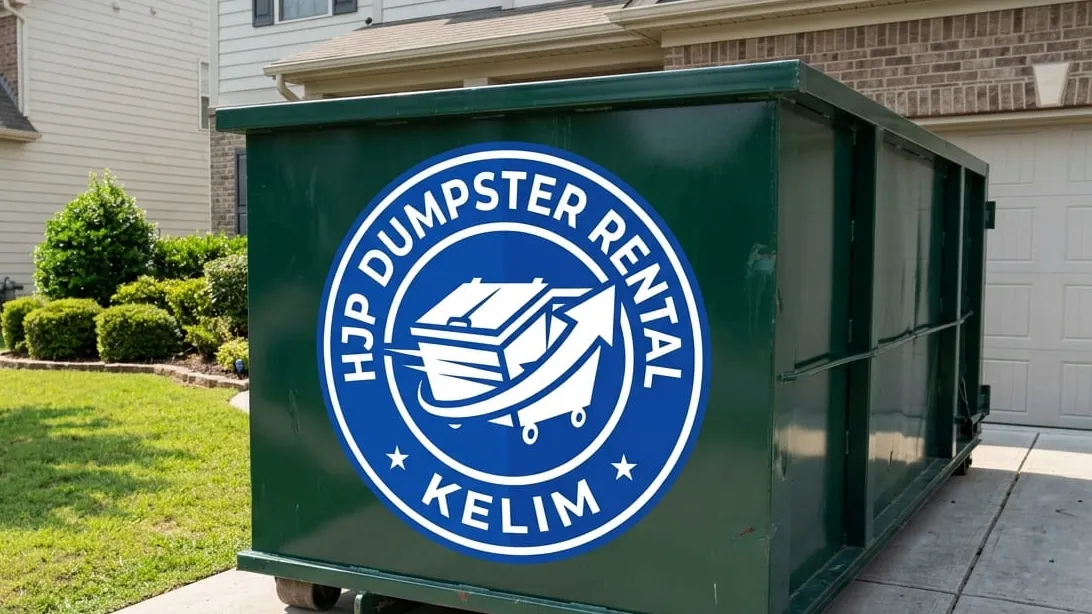
Residential
Residential Dumpster Rental in Kelim, CO
Driveway containers for houses on both sides of the Larimer–Weld line — basements, garages, hail-damaged roofs and thirty years of storage. On private ground no right-of-way permit is in play at all, and every container sits five feet clear of the eave line.
Start with the fact that decides more household jobs around here than any other, and it is not a fact about debris. There is a county line running through the middle of this town, and it decides who you call. Kelim is an unincorporated community in Larimer County — not Weld, whatever the mailing address suggests — and Johnstown is a home rule town that sits in both counties at once. The historic Parish Avenue core is on the Weld side; the whole I-25 corridor, the 2534 ground, the frontage roads and Kelim are on the Larimer side. Two houses a mile apart, same ZIP code, answer to two county governments, two building departments and two road departments. So when you call the yard, the first thing we ask is the address, and that is not a stalling tactic. It is the only way to give you the right phone number for anything the Town or a county has to sign off on.
The second fact is that houses in this market have a downstairs. Both counties publish a 30-inch frost line — Weld County’s design criteria list 30 inches for residential and commercial work, and Larimer County states a 30-inch minimum frost depth countywide. Where footings, water services and sewer laterals have to go 30 inches down anyway, the marginal cost of a full basement is small, and basements are ordinary here as a result. That changes what a residential container actually holds. The typical Kelim or Johnstown clear-out is not one room, it is a vertical stack: a finished or half-finished basement, a garage that has been absorbing overflow since the house was built, and whatever went up into the storage above. It is also why a sizing habit brought here from a warmer, flatter market will come up short. A 10 yard that would empty a bedroom somewhere else does not empty a basement here.
The third fact is the weather, and in Northern Colorado that means hail rather than rain. This is a semi-arid market — the Greeley–Weld County Airport 1991–2020 normal is 15.34 inches of precipitation a year, roughly a third of what a Southeastern market gets. What we do get is hail. NOAA’s Colorado state climate summary puts northeastern Colorado at seven to nine hail days a year, inside what it calls the nation’s most hail-prone corridor. Roof tear-off is the single most common reason a residential driveway here gets a container on it, and it does not arrive evenly. It arrives in bursts, a whole subdivision at a time, in the fortnight after a storm. If your roof took a hit, read the sequencing note in our hail and tear-off guide before you book anything — the order you do things in matters more than the size of the box.
It also helps to know what does and does not get collected for you. The Town of Johnstown provides refuse collection by contract under § 7-61(a) of its municipal code, billed monthly with the water bill under § 7-65(a), and that service does not extend to multifamily buildings of three units or more, or to commercial and industrial customers. Outside the town limits, neither Weld nor Larimer County collects residential waste at all. Weld County runs two household hazardous waste facilities free to Weld residents — 1311 North 17th Avenue in Greeley and 5500 Highway 52 in Dacono, (970) 400-2217, 200 pounds per household per visit, nothing over five gallons, and no electronics or appliances — plus a seasonal large-item voucher good for one truckload or a one-ton trailer, one per Weld County address. Larimer County residents, which is what a Kelim address makes you, use the Central Diversion and Transfer Station, 2388 W. Trilby Road, Fort Collins, (970) 498-5772. None of that is a route for a house clear-out. It is a route for a carload.
The practical end of it is simple and we will say it plainly. On private property — a driveway, a yard, a parking lot — no right-of-way permit is in play at all, and that covers the overwhelming majority of the houses we serve. If any part of the container has to sit on public ground inside the Town of Johnstown, the code is explicit: § 7-35 provides that no person shall place, store or maintain a dumpster on any public property unless expressly authorized in writing by the Town, and placement in violation is considered a nuisance. That is a call to the Town at 970-587-4664 before delivery, not after. Everything else is ordinary care: plywood under the wheels and the rear rollers, five feet clear of combustible walls and the eave line, and a tarp over the load if wind is forecast. Call the yard on (970) 427-0341 and we will size it over the phone.
What Households Around Kelim Actually Clear Out
Basement And Storage-Level Clear-Out
The big one in this market. Thirty-inch footings make basements ordinary here, and a basement absorbs a decade of boxes, shelving, a dead treadmill and the carpet that went down when the house was new. Set the box near the walkout or the garage door and the stair carry gets shorter.
Garage And Shop Clean-Out
Two- and three-car garages on the newer subdivisions fill with lawn equipment, lumber offcuts, bikes, paint and pallet racking. Drain the fuel and oil out of anything that has it, and set aside anything electronic before it goes in the box.
Hail-Damage Roof Replacement
The anchor job on this corridor. Shingles, felt, ice-and-water shield, drip edge, ridge vent, flashing and often the gutters, all arriving in a single afternoon. It is a weight load, not a volume load, so it goes in a smaller container loaded flat.
Whole-House Declutter Before A Sale
Johnstown grew 29.5 percent between 2020 and 2025 and houses turn over fast. A declutter before listing is furniture, carpet, closets, the garage and the storage level together, which is the classic 20 yard job.
Basement Finish-Out And Remodel
Framing offcuts, drywall, old paneling, subfloor, doors and trim out of a basement that is being finished properly for the first time. Dense material in a confined space, carried up a stair, so the pace is steady rather than fast.
Kitchen And Bath Rip-Outs
Cabinets, counters, tile, backer board, tub, vanity and the flooring that goes with them. A bounded job with a known volume, and the one most often sized correctly over the phone.
Fence, Deck And Shed Removal
Wind is a structural fact here — Weld County publishes a 115 mph basic residential wind speed — and fence sections, deck boards and sheds come down. Bulky rather than heavy, so the sizing logic inverts.
Storm And Wind Debris Around The House
Siding, soffit, fascia, screens, downed limbs and roof litter after a storm. Mixed debris is light and awkward, and it wants a bigger box than the weight of it suggests.
Sizing A Container For A House On This Corridor
For a single bounded job — one bathroom, one kitchen, one bay of a basement, one small roof — a 15 yard is usually right. For the ordinary whole-house declutter, the 20 yard is the default here and it is the default for a structural reason: the job is a basement plus a garage plus a storage level rather than a set of rooms, and that is more material than newcomers estimate. A 10 yard is the weight box — concrete, tile set in mortar, dirt and the spoil off a 30-inch-deep trench, all of which reach a lawful payload long before they fill anything larger. Where the house is being emptied completely, or where storm debris has filled the yard as well, step up to a 30. Roofing is the exception that runs the other way: an ordinary single-layer tear-off belongs in a 15 or a 20 and never in a 30 or a 40, because torn shingle reaches its lawful road weight while the box still looks half empty. Dimensions are on the container sizes page, and our sizing guide works through the same arithmetic in writing.
10 Yard Dumpster
Broken slab, block, brick and dirt — the box that reaches payload long before it looks full.
View this size →15yd³15 Yard Dumpster
The workhorse for an ordinary single-layer hail tear-off, or one room cleared to the walls.
View this size →20yd³20 Yard Dumpster
A whole-house declutter — the default here — a large roof, or a multi-room remodel.
View this size →Driveways, Frost, Wind And Where The Box Goes
Placement on a residential lot here comes down to four things. First, the surface: plywood goes under the wheels and under the rear rollers on every delivery, because a loaded container concentrates its weight at exactly two places and a new subdivision driveway is usually the strongest thing on the lot. On soft graded ground, a spring-thaw shoulder or a lot that has just been watered, mats matter more rather than less — we are protecting against ruts and soft ground, and we would rather set the box on the concrete than on the yard. Second, the clearance: the Town of Johnstown adopts the 2024 International Fire Code, and under § 304.3.5 a container of 1.5 cubic yards or more may not be placed within five feet of combustible walls, openings or combustible roof eave lines, with the adjacent § 304.3.4 applying the same five feet at 1.0 cubic yard. Every roll-off we run is far above both, so the answer never moves: five feet, always. Third, the wind. Chinook downslope windstorms are a recurring Front Range hazard and Weld County publishes a 115 mph basic residential wind speed, so an open container full of light material is a distribution system for it — tarp the load, or load the top course heavy. Fourth, the approach: we want roughly 60 feet of straight run for the truck, about eleven feet of working width and 20 feet of overhead clearance for the hoist, with an eye on service drops. If the driveway will not take it, tell us before delivery day and we will look at photographs first.
Not sure this is the right service? Describe the job on the phone and we will point you at the right container even if it is a different service page. Call (970) 427-0341.
Get a flat quote
Two minutes on the phone gets you a size, a price and a delivery slot. No forms.
(970) 427-0341Recommended sizes
How it works
Residential Dumpster Rental in four steps
- 1
Call us
Tell us the project, your address and when you want it. Two minutes on the phone and you have a flat price.
- 2
We deliver
Our driver walks the drop, lays protection boards and sets the container exactly where you want it.
- 3
You load it
Take your time within your rental window. Keep it level with the top rail and we handle the rest.
- 4
We haul it
Call or text when you are done. We pull it, sort what can be recovered and dispose of the rest properly.
Residential Dumpster Rental FAQs
Do I need a permit to put one on my driveway?
No. On private property — your driveway, your yard, your parking lot — there is no right-of-way permit in play at all, and that covers almost every house we serve. The permit question only arrives when part of the container has to sit on public ground. Inside the Town of Johnstown, § 7-35 of the municipal code provides that no person shall place, store or maintain a dumpster on any public property unless expressly authorized in writing by the Town, and § 11-23 requires a Town right-of-way permit for work of any kind in the public right-of-way. The Town is at 970-587-4664. Out in unincorporated Weld County, Public Works is at (970) 400-4000; in unincorporated Larimer County, Engineering is at (970) 498-5709. Our permits guide sets out what each of those desks does and does not publish.
Am I in Weld County or Larimer County?
That depends on your address, and it is worth settling before you need a permit or a building inspection. Kelim is in Larimer County. Johnstown straddles both: the old grid around Parish Avenue is on the Weld side, and the I-25 corridor, including the frontage roads and Kelim, is on the Larimer side. We are not going to tell you which road the line follows, because we could not verify a boundary alignment from an authoritative source and a wrong answer there is worse than none. If your address is on the interstate side, plan on Larimer; if it is in the old grid, plan on Weld; if it is anywhere near the middle, call the county and ask. Our county line guide lays out exactly what changes when you cross it.
What size do most houses around here take?
A 20 yard, and the reason is the shape of the housing rather than the size of the family. Thirty-inch frost depths in both counties make basements ordinary, so the ordinary clear-out is a basement plus a garage plus a storage level, not a set of rooms. That is more volume than people estimate, and the commonest mistake we see is a 10 or a 15 booked for a job that was always a 20. If the job is genuinely bounded — one bathroom, one kitchen, one bay of the basement — a 15 is right and it is cheaper. If the house is being emptied completely, take a 30. Call with a room-by-room description and we will size it in a sentence.
What can I not put in the container?
The hard bans first. Electronics have been banned from Colorado landfills since 1 July 2013 under C.R.S. § 25-17-303 — televisions, monitors, computers, printers and the rest — and the landfills serving this area list electronic waste as prohibited outright. Tires are refused locally as well, and Colorado’s waste tire rules route them to registered tire facilities instead. Then the usual: liquids, paint, fuel, oil, chemicals, pressurized tanks, batteries, hot ashes and anything containing asbestos. Household chemicals from a Weld County address can go to the county’s household hazardous waste facilities at (970) 400-2217, which take 200 pounds per household per visit but do not accept electronics or appliances. Everything else — furniture, carpet, drywall, cabinetry, roofing, fencing, yard debris — is ordinary content. Our Colorado disposal guide has the per-facility detail.
How long can I keep it?
On private ground, as long as the job needs. Call the yard on (970) 427-0341 when you want it collected and we will route it rather than hold you to a fixed day. The useful pattern on a bounded job is delivery the day before work starts and collection the day after it finishes. Two local notes on timing. Spring starts late here — the average last frost at Greeley is 12 May — so outdoor work and landscaping debris really begin in May rather than March. And in the fortnight after a significant hail event, every roofer on this corridor wants a container the same morning, which is the hardest two weeks of the year to get anything delivered anywhere in Northern Colorado. If you can book ahead of that, do.
More services
Other things we haul
Commercial Dumpster Rental
Containers for businesses and contractors along the I-25 corridor — neither county collects at the curb.
Learn more →Construction Dumpster Rental
Mixed C&D in one roll-off, with next-day swap-outs across Larimer and Weld.
Learn more →Roofing Dumpster Rental
Weight-rated cans sized by squares and layers — hail tear-off is what this market runs on.
Learn more →Roll-Off Dumpster Rental
10, 15, 20, 30 and 40 yard roll-offs across Larimer and Weld counties.
Learn more →Same-Day Dumpster Rental
Call before the cut-off and we can usually get a container to you this afternoon.
Learn more →Junk Removal Dumpsters
Clear a basement, garage, shop or outbuilding on your own schedule.
Learn more →Estate Cleanout Dumpsters
Discreet, patient container service for families clearing a lifelong home.
Learn more →Demolition Debris Removal
Containers and fast swaps for decks, outbuildings, sheds, garages and interior gut-outs.
Learn more →Concrete & Heavy Debris
Dedicated heavy cans for broken slab, block and brick, loaded flat and low.
Learn more →Yard Waste & Brush Removal
Clean separate loads — Colorado has no yard-waste landfill ban, so you have real options.
Learn more →Where we deliver
Residential Dumpster Rental across Larimer County and Northern Colorado
Same service, same flat rates, every town below. Pick yours for local placement and permit notes.
Talk to a real person
Need residential dumpster rental in Kelim?
Tell us what you are clearing out and we will tell you the right size and the flat price to put it in your driveway. No forms, no waiting on an email — just call and we will sort it out in a couple of minutes.
Serving Kelim, Larimer County and Northern Colorado · Mon–Fri 6:30am–5pm, Sat 7am–1pm