
Sizes
What Size Dumpster Do I Need in Kelim, Colorado?
A national size chart will under-size a Northern Colorado job more often than it over-sizes one. Here is how we size containers for the I-25 corridor, and the two rules that override every chart.
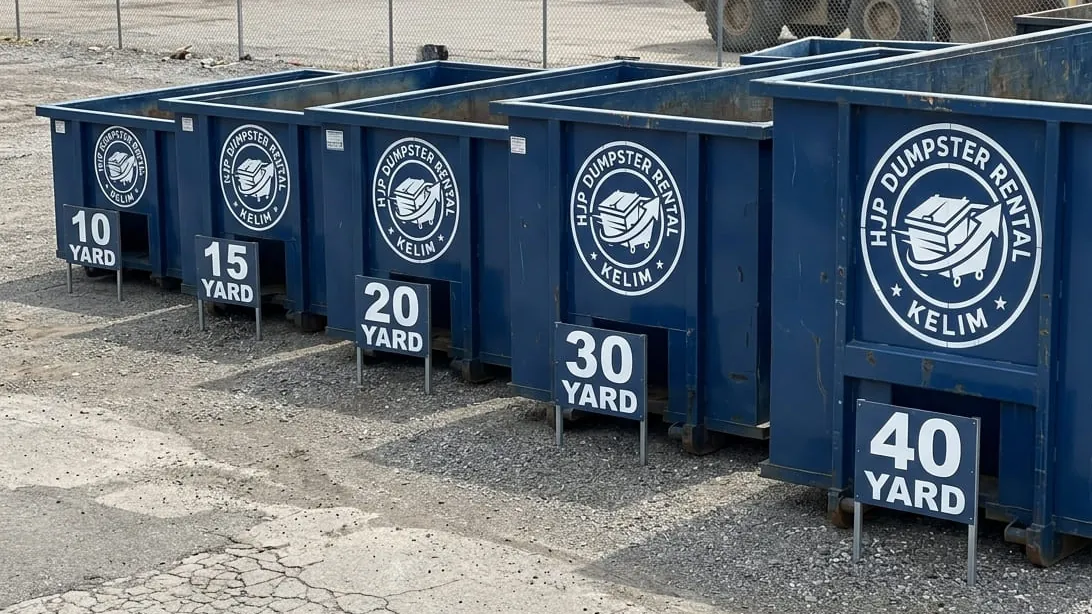
The question we get most often on the frontage road is the simplest one and the hardest one. How big a box do I need? A national size chart will tell you a 20-yard container is right for a whole-house declutter, and here that is genuinely true. But almost everything else on those charts was written for a warmer, wetter, shallower-footing part of the country, and it will under-size a job in Northern Colorado more often than it over-sizes one.
Here is how we actually size a container for a job in Kelim, Johnstown, Milliken and the rest of the I-25 corridor, and why the answer moves the way it does.
The short version
- 10 yard — heavy debris only. Concrete, brick, asphalt, dirt, tile, plaster. One room of demolition. A small bathroom gut.
- 15 yard — a single-room remodel with mixed debris, a modest roof, a garage that has been filling since 2009.
- 20 yard — the default. A whole-house declutter, a basement clean-out, a kitchen gut, most residential roofs.
- 30 yard — a large remodel, a new-construction framing and drywall stage, a full estate clear-out with furniture.
- 40 yard — bulky, light debris at volume. Commercial clean-outs, siding, insulation, packaging, cardboard, a large demolition of light-frame material.
Two rules override all five lines above, and they are the ones that matter locally.
Rule one: roofing never goes in a 30 or a 40. Tear-off debris is dense enough that a container reaches lawful road payload long before the box looks full. A 30 that is a third full of shingles is a truck that cannot legally leave your driveway. We talk about that in detail in our hail damage and roof tear-off guide, because on this stretch of the Front Range roofing is the job we run more than any other.
Rule two: dirt, concrete and masonry go in a 10. Not because a 10 holds much, but because it holds the right amount. The same physics applies — weight, not volume, ends the load.
Why the Colorado answer is different
Three local facts move sizing here, and none of them appear on a national chart.
A thirty-inch frost line means deeper digs and more spoil
Both counties that meet in this market publish the same number. Weld County’s design criteria list a frost line depth of 30 inches for residential and commercial work alike, and Larimer County’s structural design information states that the minimum frost depth is 30 inches below grade countywide. Footings, water services and sewer laterals are set below that line.
The practical consequence for a container is arithmetic. A sewer lateral replacement, a footing repair, an egress window well, a frost-protected pier for a deck — every one of those digs deeper here than the same job would in a mild climate, and every extra inch of depth is spoil that has to go somewhere. Excavated soil is one of the heaviest things anybody ever puts in a roll-off. If your project involves a trench, tell us the length and the depth and we will size on weight rather than on the hole’s appearance.
Basements are normal, and basements are heavy
Where the code already makes you dig 30 inches, the marginal cost of going all the way down is small, which is why full basements are ordinary in this market and rare in the places most sizing advice was written for. That changes the job mix. A finished basement being un-finished produces drywall, framing, carpet, pad, tile, cabinetry and sometimes a concrete slab cut — a dense, mixed stream that fills a container by weight well before it fills it by volume.
A bedroom remodel in a house with no lower level is a 10-yard job. The same square footage in a Johnstown basement is usually a 20. Our basement and crawlspace clean-out guide walks through the sequence.
Hail decides the roofing calendar
Northeastern Colorado averages seven to nine hail days a year and sits inside the most hail-prone corridor in the country, according to NOAA’s Colorado state climate summary. That is not a background statistic here — it is the demand curve. A single storm can put an entire subdivision’s roofs into replacement at once, and the containers that follow are all sized the same way: by squares and by layers, never by how the pile looks in the driveway.
The five sizes, one at a time
The 10-yard
Small footprint, high density. This is the concrete and dirt box. It is also the right answer for a single bathroom gut, a small shed demolition, or a tile removal where the substrate is coming up with it. If you are calling about a patio slab, a sidewalk, a hearth, a retaining wall or a driveway apron, this is almost certainly the container, and there will usually be a weight limit rather than a fill line. See the 10-yard and our concrete and heavy debris service.
The 15-yard
The size people forget exists. It suits a one-room remodel with mixed debris, a modest single-layer roof on a smaller ranch, a garage or storage-unit clear-out, or a deck tear-off. On a tight lot — and there are plenty of those in the newer subdivisions off 2534 — the shorter box is often the difference between setting on the driveway and not setting at all. See the 15-yard.
The 20-yard
The default, and it earns the title. Whole-house declutter, kitchen gut, basement finish-out, most residential roofs, a serious downsizing before a move. If you are unsure between two sizes and the debris is mixed household material, the 20 is the one that goes wrong least often. See the 20-yard and our residential service.
The 30-yard
Volume without extreme density. A large remodel, a whole-house estate clear-out with furniture and mattresses, a new-construction framing and drywall stage. With 528 single-family permits issued in Johnstown in 2025 and more than 900 residential permits in total, the 30 is the working container on a lot of job sites in this market. See the 30-yard and our construction service.
The 40-yard
Bulky and light. Commercial clear-outs, cardboard and packaging, insulation, siding, light-frame demolition, a retail fixture strip-out along the I-25 retail corridor. It is the wrong box for anything dense. See the 40-yard and our commercial service.
Weight is the constraint, not volume
Almost every sizing mistake we see comes from thinking in cubic yards when the truck and the scale think in tons. Materials that end a load early:
- Asphalt shingles, especially a second layer
- Concrete, brick, block, stone, mortar and asphalt
- Excavated soil, sod and clay-bearing fill
- Ceramic and porcelain tile, and the mortar bed under it
- Plaster and lath from the older housing in the Parish Avenue core
- Wet carpet and pad after a basement water event
- Dimensional lumber in quantity — framing scrap is heavier than people expect
Materials that eat volume without weight: furniture, mattresses, cabinetry, insulation, packaging, siding, fencing and brush. Those are the loads that justify stepping up a size rather than adding a second pull.
The most useful thing you can tell us is not a size. It is a description: what the material is, roughly how much of it, and whether it came off a roof, out of a basement or out of the ground.
What the county voucher does and does not replace
Weld County runs a seasonal large-item disposal voucher covering one truckload level with the bed rails, or one trailer weighing up to one ton, free of charge, one per Weld County address, redeemable at the participating landfills. It is a genuinely good program and worth knowing about. It is also, by design, one ton. A roof tear-off, a basement gut or a house clear-out is a multiple of that, and the voucher is capped at one per address per season. Weld County’s household hazardous waste line is (970) 400-2217, and the county publishes both programs at weld.gov.
Kelim itself is in Larimer County, where residents use the Central Diversion and Transfer Station, 2388 W. Trilby Road, Fort Collins, (970) 498-5772. Neither county collects residential waste at the curb. If you are working out whether a self-haul or a container makes more sense, our county-line guide explains which set of facilities and desks your address actually belongs to, because on this side of Johnstown that is a real question.
Yard waste and brush
Colorado does not have a statewide landfill ban on yard waste, and the landfills serving this area list it among accepted materials. That said, composting capacity within reach is substantial — there are three permitted composting facilities in Weld County alone — and some towns and haulers route green waste separately, so it is worth asking rather than assuming.
For sizing purposes, brush is bulky and light. Branches trap enormous amounts of air, and a load that looks full is often half air. Cutting to length before loading is the single highest-value thing you can do for a brush container. See our yard waste service and the brush removal guide.
One seasonal note that catches transplants out: the average last spring frost at Greeley is 12 May. Yard and landscape season starts later here than most people expect, and it ends with a hard frost in early October.
Where the box will sit, and why that affects the size
Size is not only a debris question. It is a driveway question.
A 40 needs more straight approach and more overhead clearance than a 15, and a loaded container needs the ground under it to stay where it is. Front Range driveways are usually fine; the soft shoulder beside them, after a spring rain, is not. Plywood under the wheels and the rear rollers is cheap insurance, and it is the standard we work to. Our driveway protection guide covers it properly.
There is also a fire-code separation to plan for. Under the International Fire Code as adopted by the Town of Johnstown, a dumpster of 1.5 cubic yards or more may not be placed inside a building or within five feet of combustible walls, openings or combustible roof eave lines — and a related section applies the same five-foot rule at 1.0 cubic yard with an exception for containers built of noncombustible material. Every roll-off container is far larger than either threshold, so the practical answer never changes: five feet, always. Front Range Fire Rescue, the fire district serving Johnstown and Milliken, is at 970-587-4464. Placement rules are covered fully in our Johnstown permits guide.
And on public property, the rule is explicit. Johnstown Municipal Code § 7-35 provides that no person shall place, store or maintain a dumpster on any public property unless expressly authorized in writing by the Town. On your own driveway, none of that is in play.
What to tell us when you call
- The address, not the town. In this market the mailing address and the jurisdiction are two different things.
- What the debris is. Roof, basement, kitchen, garage, dirt, concrete, brush, furniture.
- How much of it. Squares for a roof. Rooms for an interior. Length and depth for a trench.
- Where it should sit. Driveway, side yard, alley, job site, street.
- When you need it and how long you need it. Roofing crews want it the morning they start; clear-outs want it for a week.
Give us those five things and we can size it on the phone, usually in under two minutes. Compare the full lineup on our dumpster sizes page, check coverage on service areas, or read the FAQ.
Call HJP Dumpster Rental at (970) 427-0341. We have been running containers out of our yard on the Kelim frontage road since 2013, and we would rather size it right the first time than sell you a second pull.
Questions this guide did not answer? Call (970) 427-0341. We would rather spend two minutes on the phone than have you order the wrong container.