Storm Cleanup
Flood and Storm Debris Cleanup on the Front Range
Fifteen inches of rain a year, and every drop of trouble arrives at once. The four hazards that generate debris here, and the different container each one needs.
This corridor gets about fifteen inches of precipitation in a year. It is semi-arid country. People move here from wetter places and conclude, reasonably enough, that water is not the problem.
Then they find out how the water arrives.
The hazards that actually generate debris in this market are four, and they are all sudden: hail, downslope wind, tornado, and cloudburst river flooding. Each one produces a different pile in the yard, and each one wants a different container. This is the guide to all four.
September 2013 — the event this market measures things against
Rain fell across the Front Range from 9 to 16 September 2013. The Big Thompson, the Little Thompson and the South Platte all came up.
Those first two rivers are not abstractions here. Harvey Parish homesteaded the ground between the Big Thompson and the Little Thompson in about 1883, and the town he founded in 1902 sits on it. The founding story and the flood story are the same two rivers.
What happened locally is documented by the Colorado Department of Transportation, whose own account of the damage to Colorado 60 — the highway through Milliken and Johnstown — states it plainly: “The Town of Milliken and portions of Johnstown were completely isolated due to flood damage to CO 60.” At the Little Thompson River bridge there was erosion and washout of embankment at the abutments and loss of guardrail. At the South Platte River bridge three miles east of Milliken, the bridge was overtopped and “10 feet of roadway pavement and embankment were washed out, exposing the bridge support piles.” The highway reopened with temporary repairs on 21 September 2013. codot.gov.
Downstream in Evans, homes were damaged or destroyed, two mobile home parks were lost, and the city’s main wastewater treatment plant was heavily damaged. Regionally, the September 2013 floods killed eight people, destroyed nearly 2,000 houses and damaged 28,000 more across seventeen counties.
We are not going to publish local rainfall totals, peak discharges or damage figures for Johnstown, Milliken or Kelim, because the federal assessment of that event focused elsewhere and we could not source those numbers to this ground. The verified sentence — two towns cut off by a highway washout — is the one that matters anyway.
Hail: the one that arrives most often
Northeastern Colorado averages seven to nine hail days a year and lies inside what NOAA’s Colorado state climate summary calls the nation’s most hail-prone corridor. In 2025, Colorado ranked sixth in the country with 244 hail events of one inch or larger, out of a national total of 5,432, per Insurance Information Institute figures citing NOAA Storm Prediction Center data.
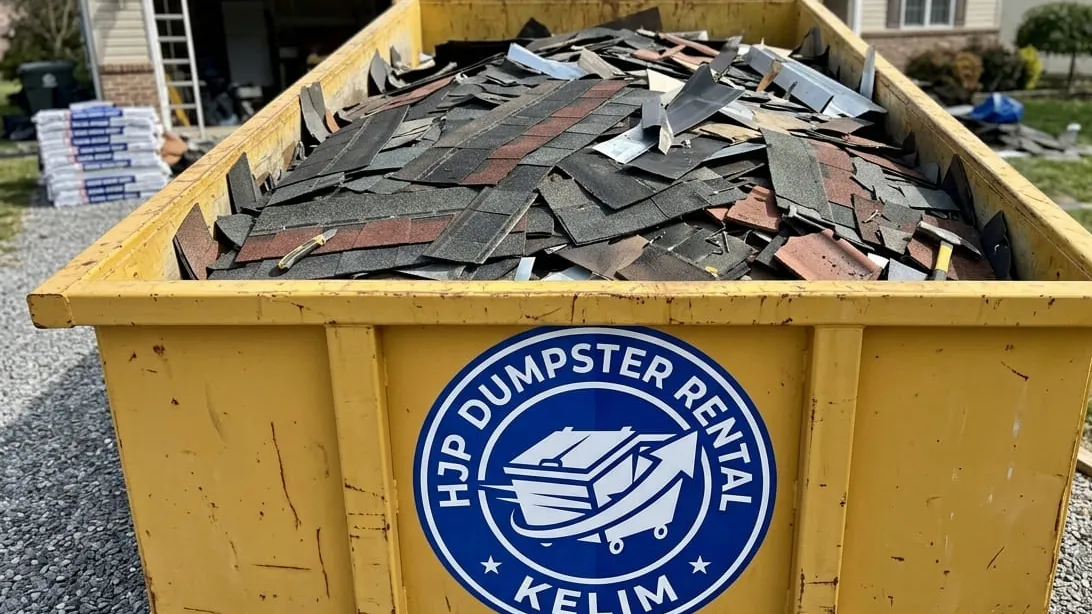
Hail debris is dense, and it is mostly roof. That has one hard consequence: roofing never goes in a 30-yard or a 40-yard container, because tear-off reaches lawful road payload long before the box looks full. The full treatment is in our hail and roof tear-off guide; the short version is that roofs get sized by squares and layers, and the answer is usually a 15-yard or a 20-yard.
Wind: chinooks, and why an empty container is a sail
Downslope chinook windstorms are a recurring Front Range winter hazard. NOAA has documented Front Range gusts as high as 137 mph during the January 1982 event, with Fort Collins — fourteen miles from Kelim — taking the brunt on 24 January of that month.
The design numbers corroborate it. Weld County publishes a 115 mph basic residential wind speed. Larimer County publishes site-specific basic wind speeds ranging from 115 to 225 mph. No jurisdiction adopts numbers like that unless wind is a first-order structural concern.
Wind debris is the opposite of hail debris: bulky, light and awkward. Fence sections, siding, soffit and fascia, shingles, shed panels, trampolines, patio furniture, downed limbs. It fills volume fast and weighs very little, which is exactly the case a 30-yard is built for.
Two operational notes that come straight out of the wind:
- Cover the load. Light debris does not stay in an open box in a gusty afternoon, and Front Range Landfill publishes that all incoming loads are subject to random inspection and that uncovered or unsecured loads will be charged double.
- An empty container is a sail. A box delivered ahead of a storm and left empty overnight can move. Get weight in the bottom of it or take delivery the morning you will fill it.
Tornado: the county nobody expects
Weld County has recorded more tornadoes than any other county in the United States — 252 confirmed sightings between 1950 and 2011.
The nuance matters, because a local will catch it if you get it wrong. Most of those are landspouts: short-lived, non-supercell tornadoes forming along the Denver Convergence Vorticity Zone. That mechanism is why the count is so extraordinary without the county being notorious for catastrophic tornadoes.
But the exception is in living memory and it is close. The Windsor tornado of 22 May 2008 destroyed 78 homes, about five and a half miles from Kelim. That is what a serious one does here, and it is why storm-debris work in this market means structural material and not just yard cleanup.
For watches and warnings, the correct forecast office for both Weld and Larimer counties is NWS Denver/Boulder. The other Colorado office serves the western slope and is the wrong one for this side of the divide.
Flooding: what to do in the first two days
Flood cleanup is the one where the order genuinely matters, and where moving fast on the wrong thing costs the most.
- Utilities first. Do not re-enter standing water with power on. Gas, electric, and any appliance that has been submerged.
- Document before you remove. Photograph and video every room, every wall, the water line on the drywall, the contents, the serial plates on appliances and the mechanical equipment, before anything moves. Once it is in a container it is gone as evidence.
- Treat floodwater as contaminated. River flooding carries sewage, fuel, agricultural chemicals and whatever was in the buildings upstream. Gloves, boots, eye protection and a respirator, not a dust mask.
- Then get wet material out fast. Mold does not wait for an adjuster. Carpet and pad, wet drywall cut above the water line, batt insulation, particleboard cabinetry and furniture, wet subfloor.
- Dry aggressively. Air movement and dehumidification, for longer than feels necessary.
What comes out is waterlogged and heavy — saturated carpet, wet drywall and soaked insulation weigh several times their dry weight. Size a flood job the way you would size a demolition, not the way you would size a declutter. A 20-yard with a scheduled second pull usually beats a 30 that cannot be hauled full.
If the property is near a river and the repair involves work in the floodplain, Larimer County issues a floodplain development permit among its engineering permits — (970) 498-5709, larimer.gov. We will not tell you whether any particular address is in a mapped flood hazard area, because we have not retrieved the flood maps and a wrong answer there is somebody’s insurance.
Sorting the pile
Storm debris arrives as one heap and has to leave as four.
- Vegetative — limbs, brush, trunk sections. Handled in the yard waste and brush guide. Worth knowing that Colorado has no statewide landfill ban on yard waste, and the landfills serving this area advertise accepting yard waste and tree branches. Composting is also widely available.
- Construction and demolition — shingles, siding, fencing, decking, drywall, framing, flooring. This is the container load. See construction debris disposal.
- Household contents — furniture, mattresses, carpet, clothing, boxes.
- The prohibited streams — below.
What cannot go in the container, storm or no storm
- Electronics. Banned from Colorado landfills since 1 July 2013 under C.R.S. § 25-17-303. A flooded basement full of ruined electronics is exactly the load this rule catches.
- Tires. Refused outright by the landfills serving this area; ten or more requires state registration to transport.
- Household hazardous waste. Fuel cans, propane cylinders, paint, solvents, pesticides, pool chemicals, batteries. Weld County residents have two free facilities: 1311 North 17th Avenue, Greeley (Tue, Thu, Sat 8–5) and 5500 Highway 52, Dacono (Wed, Fri, Sat 9–4), (970) 400-2217 — 200 pounds per household per visit, nothing over five gallons, no leaking containers, nothing in plastic bags, and no electronics or appliances.
- Refrigerant appliances. Professional coolant removal first.
- Asbestos-containing material. On a pre-1989 building, CDPHE’s Regulation 8, Part B governs — single-family triggers of 32 square feet or 50 linear feet, a certified inspection first, and a ten working-day notification for removal above triggers or for any demolition activity. CDPHE asbestos: 720-507-5136, cdphe.colorado.gov.
Kelim is in Larimer County — not intuitive when the mail says Johnstown, but Johnstown straddles two counties and the I-25 corridor is on the Larimer side. Larimer residents use the Central Diversion and Transfer Station, 2388 W. Trilby Road, Fort Collins, (970) 498-5772. See the county line guide and the disposal rules guide.
Do not burn it, and do not bury it
The instinct in farm country after a wind event is a burn pile. Two problems with that here.
First, open burning is restricted by the local fire protection district, not by the county. Unincorporated Weld County enforces no fire code of its own — its building ordinance provides that the International Fire Code applies only when adopted by a local fire district. For Johnstown and Milliken the authority is Front Range Fire Rescue, 970-587-4464, frfr.colorado.gov, whose adopted amendments address prohibited open burning, burn permits and bonfires directly. That is the number, not the county.
Second, burying it on your own ground is not the shortcut it looks like. Weld County’s waste program states that a landowner disposing of their own waste on their own property must submit a design and operations report to the county and to CDPHE for review and approval before disposing of it.
Where the box goes after a storm
On a driveway, a yard or a private lot, no right-of-way permit is in play at all. That is the answer for most storm cleanups.
Debris piled in the street is a different matter. Inside the Town of Johnstown, § 7-35 is explicit — no person shall place, store or maintain a dumpster on any public property unless expressly authorized in writing by the Town, and placement in violation is considered a nuisance — and § 11-23 requires a Town right-of-way permit for work of any kind in the public right-of-way. Town Hall: 970-587-4664. Outside town, Weld Public Works is (970) 400-4000 and Larimer Engineering is (970) 498-5709. More in the permits guide.
And five feet, always, from combustible walls, openings and combustible roof eave lines — the 2024 International Fire Code as adopted by the Town of Johnstown, § 304.3.5 at 1.5 cubic yards and § 304.3.4 at 1.0 cubic yard with a noncombustible exception. Every roll-off exceeds both thresholds.
After a storm the ground is soft and the driveway may be under debris. We bring plywood; see the driveway protection guide for what to clear first.
Being realistic about the week after
A significant hail or wind event puts an entire subdivision into the same queue at the same hour. Add the growth — Johnstown went from 17,303 residents in 2020 to an estimated 22,433 by mid-2025 and issued 528 single-family permits in 2025 — and the trucks in this corridor are already committed before the storm arrives.
What helps: call early even if the crew is not booked; tell us the debris type so we bring the right box the first time; and give us the address rather than the town, because in this market the address decides which county, which road authority and which fire district you are dealing with.
We have been running containers out of our yard on the Kelim frontage road since 2013. We know what the week after looks like. Call HJP Dumpster Rental at (970) 427-0341. Junk removal · demolition debris · sizes · FAQ.
Questions this guide did not answer? Call (970) 427-0341. We would rather spend two minutes on the phone than have you order the wrong container.