
Delivery
Driveway Protection: What Happens When the Truck Arrives
A loaded roll-off is the heaviest thing that will ever sit on a residential driveway. Almost every complaint traces back to a thirty-second call nobody made before delivery.
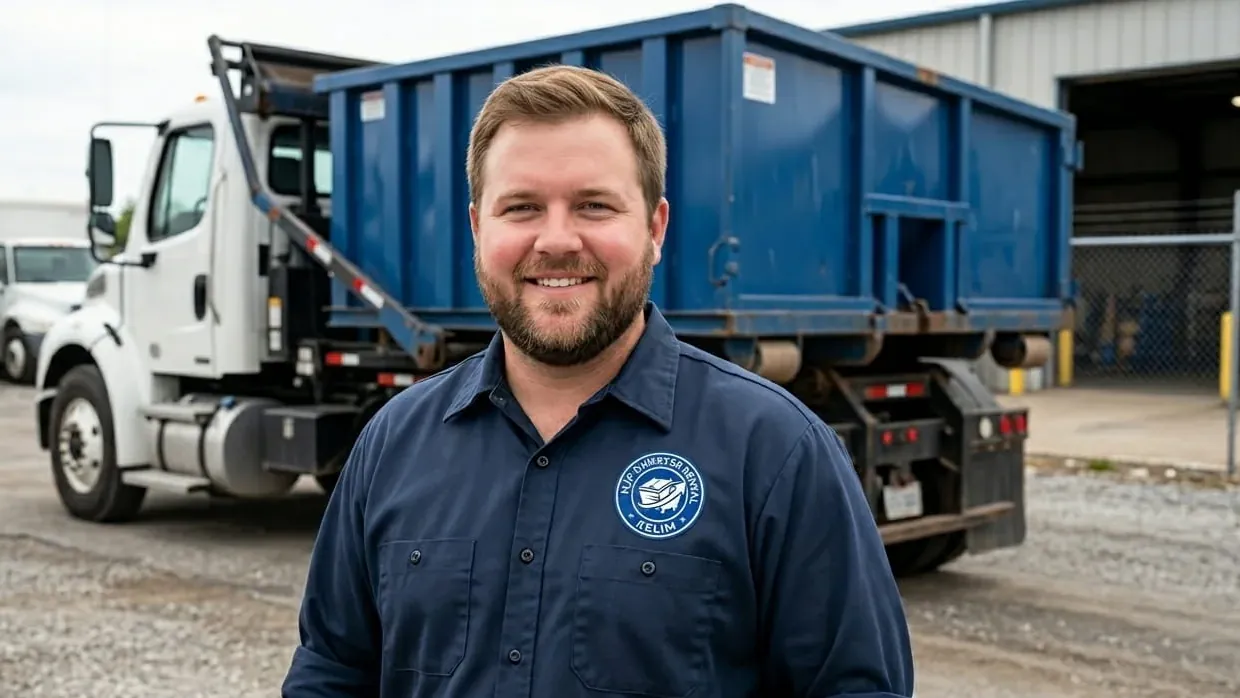
A loaded roll-off container is, by a wide margin, the heaviest thing that will ever sit on a residential driveway. The truck that brings it is heavier still. And the whole transaction happens in about four minutes, usually while nobody is home.
Almost every driveway complaint in this trade traces back to something that could have been settled in a thirty-second phone call before delivery. This is that phone call, written down.
What actually damages a driveway, and what does not
People picture the container crushing the surface uniformly. It does not work that way. Damage happens at point loads — small areas carrying disproportionate force — and there are only a few of them:
- The rear rollers. When a roll-off is set down, the back wheels of the container touch first and take the entire weight of the box through two small contact patches while it rolls off the rails. Same on pickup, in reverse.
- The front rail feet. Once the box is down, the front end rests on steel rails that concentrate the load along two narrow lines.
- The truck’s rear axles, at the point where the truck stops on the drive.
- Turning under load. A truck that turns its steer tires while stationary scuffs asphalt badly. Rolling turns only.
Our answer to all four is the same and it is not complicated: plywood. We set sheets under the rear rollers and under the front rails as a matter of course, which spreads those point loads across a much larger area. It is the single most effective thing anyone does about driveway protection, and it takes under a minute.
Asphalt, concrete and pavers behave differently
Concrete is the most forgiving. A residential concrete drive in reasonable condition handles a loaded container without drama. Existing cracks and cold joints are where trouble shows up, because that is where the slab is already articulating.
Asphalt is a different material in July than it is in January. It softens with heat, and at 4,938 feet the summer sun on a black surface is not gentle. On a hot afternoon, asphalt takes an impression from a steel roller far more readily than the same drive would in October. If a drive is asphalt and the forecast is hot, we plan for extra plywood, or we set the box early in the day, or we look for another spot.
Pavers and stamped or decorative concrete are the ones we ask about specifically. Pavers ride on a sand-and-base setting bed that will rut and settle under sustained load, and once a paver field has dipped it usually has to be lifted and reset. Colored, stamped or exposed-aggregate surfaces show scuffs that a broom-finished slab hides completely. If the drive is any of these, tell us at booking and we will look for the apron, the street-side pad or a yard placement instead.
The ground beside the driveway
A lot of placements in this market are not on a driveway at all — they are on a gravel pad, a graded shoulder, a farm approach or a lawn. That is fine. It just needs thinking about.
The variable that matters is how soft the surface is on the day, and there are three predictable times when it is soft here:
- Spring. The average last frost around Greeley is 12 May. Before that, the ground goes through a freeze-thaw cycle almost daily, and a surface that is hard at eight in the morning can be soft mud by two in the afternoon. Spring is the season we rut lawns and gravel drives if nobody thinks about it.
- After irrigation. This is farm country, and it is irrigated. A field edge, a pasture approach or a lawn that has been on a set schedule is a different surface an hour after the water runs than it is two days later. Turn the system off the day before delivery.
- After one of the cloudbursts. This corridor averages only about fifteen inches of precipitation a year, so people forget that it can arrive all at once. It does.
On soft ground the fix is more plywood, or timber mats, or moving the placement to firmer ground and accepting a longer carry. What we will not do is drive a loaded truck across saturated turf and hand you a rut you will be filling for a year.
What we need cleared before we arrive
This is the short list that saves the most missed mornings:
- Vehicles. All of them, including the one parked on the street directly opposite the drive. We need room to back straight in.
- Overhead. A roll-off truck raises its hoist high to set and to retrieve a box. Low branches, power drops to the house, cable and phone service lines, basketball hoops and any roofed structure over the drive are all in play. If there is anything above the drive, tell us what and roughly how high.
- Length. Roughly the length of the container plus the length of the truck, in a straight line. A 20-yard on a short suburban drive frequently means the truck is out in the street during the set, which is fine but needs to be planned rather than discovered.
- Gates and side yards. Measure the actual opening, not the fence panel. Post to post.
- Sprinkler heads, drip lines and valve boxes. These are the most commonly damaged things on any delivery and they are invisible from the cab. Flag them.
- Septic tanks, lids and leach fields. On an unincorporated property, this matters a great deal. Never let a loaded container sit over a leach field or a tank lid.
- Snow and ice. A cleared, sanded path. A loaded truck on a sloped icy drive is a genuinely dangerous piece of equipment, and we will decline a placement rather than slide into a garage door.
The five-foot rule, which is about placement too
People think of the fire code as a paperwork issue. It is actually a placement instruction, and it decides where the box can go.
The Town of Johnstown adopts the 2024 International Fire Code. Under § 304.3.5, dumpsters and containers of 1.5 cubic yards or more shall not be stored in buildings or placed within five feet of combustible walls, openings or combustible roof eave lines. The adjacent § 304.3.4 applies the same five-foot rule at 1.0 cubic yard, with an exception for containers built of noncombustible or low heat release material. Every roll-off exceeds both thresholds, so: five feet, always. The eave line counts, which is why roofing placements are the fiddly ones — see the roof tear-off guide.
Front Range Fire Rescue serves Johnstown, Milliken and Weld County and will answer a placement question: 970-587-4464, frfr.colorado.gov. Note that unincorporated Weld County enforces no fire code of its own — its building ordinance provides that the International Fire Code applies only when adopted by a local fire district, so out there the district is the authority rather than the county.
Driveway, yard, parking lot — or the street
Here is the line that covers the large majority of residential jobs, and it is worth stating flatly:
On private property — a driveway, a yard, a parking lot — no right-of-way permit is in play at all.
The street is a different question, and in this market it has three possible answers depending on an address rather than a town name.
- Inside the Town of Johnstown, on either side of the county line, § 7-35 is explicit: no person shall place, store or maintain a dumpster on any public property unless expressly authorized in writing by the Town, and placement in violation is considered a nuisance. § 11-23 requires a Town right-of-way permit for work of any kind in the public right-of-way, with a fee set by resolution of the Town Council under § 11-25. Town Hall: 970-587-4664, johnstownco.gov, code at ecode360.
- Unincorporated Weld County — Public Works, (970) 400-4000. The county requires permits for construction activities within its rights-of-way and describes covered activity as including occupation of them. Its published page does not name containers, so we will not tell you it definitively covers one. The language is broad and the call is warranted.
- Unincorporated Larimer County — Engineering, (970) 498-5709. Larimer issues right-of-way construction, access and floodplain permits, all quoting ten business days. Its published documentation does not address container placement in the right-of-way in either direction, so we give you the number and claim nothing beyond it.
Kelim itself is unincorporated Larimer County. Which desk you get depends on the address, not the mailing city — our county line guide explains why. Full detail in the permits guide.
While the box is sitting there
Load it evenly. Heavy material distributed along the floor rather than piled at one end. A box loaded entirely at the back puts its whole weight through the rear rollers for the days it sits, and that is exactly the point load we spent a sheet of plywood avoiding.
Stay below the rails. A load above the top rail cannot be legally hauled and cannot be covered.
Cover it. Two concrete reasons. First, wind: chinook downslope windstorms are a documented Front Range hazard, with NOAA-recorded Front Range gusts as high as 137 mph in the January 1982 event, and Weld County publishes a 115 mph basic residential wind speed while Larimer County publishes site-specific speeds from 115 to 225 mph. A jurisdiction does not adopt numbers like that unless wind is a first-order concern. An open container full of insulation, packaging and felt paper is a distribution system for your neighbors’ yards. Second, Front Range Landfill publishes that all incoming loads are subject to random inspection and that uncovered or unsecured loads will be charged double.
An empty container is a sail. If a box is going to sit empty overnight in a wind event, get something in the bottom of it or let us come back for it.
Do not let it stand longer than the job needs. Rental days are the cheap part of a cleanout; a container that sits for three weeks on an asphalt drive through a hot spell is where impressions come from.
The things people ask us to do that we will not
Three, and they are all the same answer in different clothes.
We will not set a loaded box on a paver drive without a conversation first. We will not drive a loaded truck across a saturated lawn because the alternative is a longer carry. And we will not place on a sloped, iced driveway in January because somebody has a crew booked. In each case there is a workable alternative — a different spot, a different day, a smaller box, timber under the wheels — and the alternative is always cheaper than the repair.
A note on what we are not going to claim
No delivery method makes damage impossible. Plywood, a walked placement, a clear path and a sensible load spread the risk down a great deal, and thirteen years of doing it that way out of our yard on the Kelim frontage road is why we bother. But a drive with an existing crack, a failing base or a soft edge is a drive with an existing crack, a failing base or a soft edge, and the honest thing to do is walk it with you and say so before the truck backs in rather than after.
The five-minute checklist
- Pick the spot and walk it. Firm, level, five feet clear of the house.
- Move every vehicle, including the one across the street.
- Look up. Branches, service drops, hoops.
- Flag sprinkler heads, valve boxes, septic lids and anything shallow.
- Turn the irrigation off the day before.
- Clear and sand in winter; check the forecast for heat in summer if the drive is asphalt.
- Tell us the surface type and any constraint at booking, not on arrival.
Tell us what the drive is made of and where you want the box, and we will bring the plywood. Call HJP Dumpster Rental at (970) 427-0341. Roll-off service · sizes · service areas · FAQ.
Questions this guide did not answer? Call (970) 427-0341. We would rather spend two minutes on the phone than have you order the wrong container.