
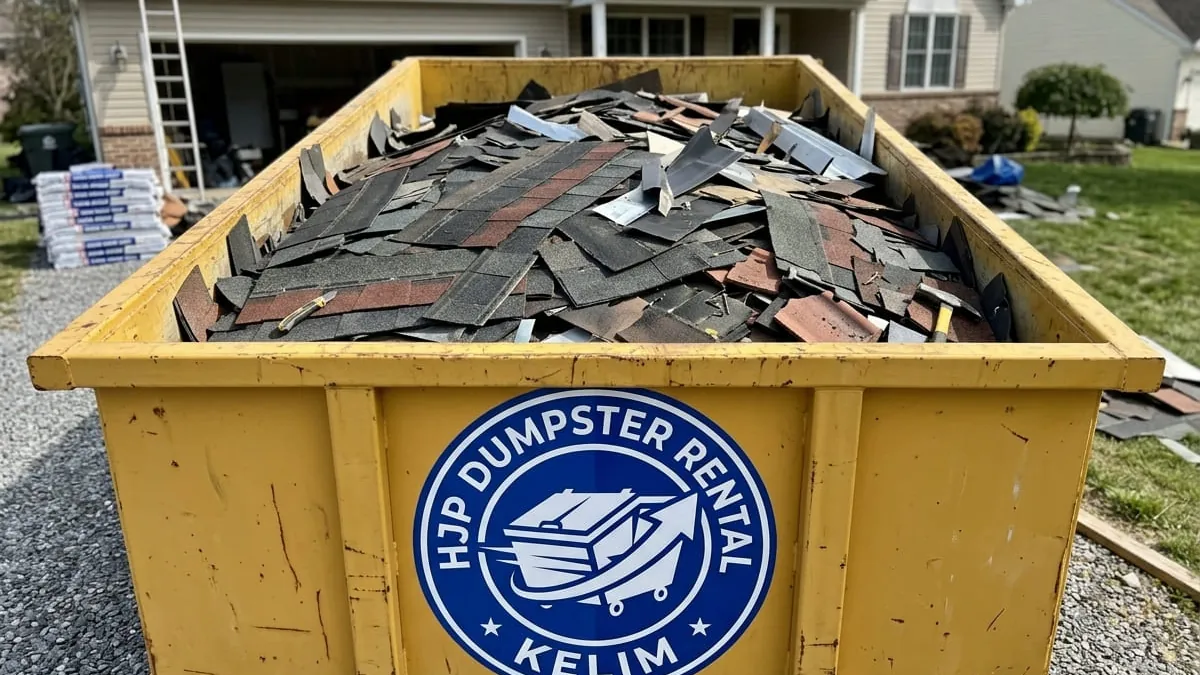
Roofing
Roofing Dumpster Rental in Kelim, CO
Tear-off containers for the most hail-prone corridor in the United States — seven to nine hail days a year, and whole subdivisions re-roofed in the same fortnight. Sized by squares and layers, set five feet clear of the eave line, loaded flat and covered before it moves.
Everything about running containers on this stretch of the Front Range is organized around one weather event, and it is not rain. This is a semi-arid market that takes about fifteen inches of precipitation in a year. It is hail. NOAA’s Colorado state climate summary puts northeastern Colorado — which is exactly where Kelim, Johnstown, Milliken, Windsor and Greeley sit — at an average of seven to nine hail days a year, inside what it calls the nation’s most hail-prone corridor. The same summary records a May 2017 Denver hailstorm with insured losses above $2 billion, Colorado’s costliest such event on record. The Insurance Information Institute, citing NOAA Storm Prediction Center data, put Colorado sixth in the country in 2025 with 244 hail events of one inch or larger. Roof tear-off is the job we run more than any other here, and it does not arrive evenly — it arrives in bursts, a whole subdivision at a time, in the two weeks after a storm.
The first thing to get right is the order you do things in, because it costs more to get wrong than the container costs. Photograph the roof, the gutters, the downspouts, the window screens, the soft metal on vents and flashing, the deck rail, the siding and any hail still lying on the ground. Soft-metal bruising is often the most legible evidence a roof took a hit. Then get it looked at before it comes off — if an adjuster is going to inspect, the roof has to still be there. Only then book the container. A box sitting on a driveway waiting for an inspection is rental days you are paying for and a container somebody else on your street needs. The exception is emergency mitigation: tarping an opening, sweeping glass and getting water out of a house is immediate work, it produces its own small debris stream, and it usually wants a small box or none at all.
The second thing is the rule that never bends: roofing never goes in a 30 yard or a 40 yard. Not because it will not fit — because it will not travel. Every roll-off has a lawful road payload as well as a volume, and tear-off debris is dense enough that it reaches that payload long before the box looks full. A 30 a third full of shingle is a truck that cannot legally leave your driveway, and the only thing that fixes it is unloading it by hand. So we size a roof on two numbers, and neither of them is cubic yards. Squares — how many hundred square feet of roof surface, which on a cut-up roof with hips and dormers is a good deal more than the footprint of the house. And layers — one or two, because a second layer roughly doubles the debris off the same square footage. Give us those two numbers and the container is a two-minute decision. Count what comes off with the shingle as well: underlayment and felt, ice-and-water shield, drip edge, valley and step flashing, ridge vent, pipe boots, damaged decking and, very often, the gutters.
The third is where the box can actually sit, and this is the conflict specific to roofing. The place a crew wants the container is directly under the eave, so the debris goes over the edge and straight in. The fire code says that is exactly where it cannot go. The Town of Johnstown adopts the 2024 International Fire Code. Under § 304.3.5, dumpsters and containers with an individual capacity of 1.5 cubic yards or more shall not be stored in buildings or placed within five feet of combustible walls, openings or combustible roof eave lines. The adjacent § 304.3.4 applies the same five-foot rule at 1.0 cubic yard, with an exception where the container itself is of noncombustible or low heat release construction. Every roll-off is far above both thresholds, so the answer never changes: five feet, always, and the eave line counts. The workarounds are ordinary — set the box on the drive five feet clear and run a plywood or tarp chute to it, set it along a gable end instead of under an eave, or move it once mid-job on a big cut-up roof. None of that is difficult if it is planned at delivery rather than discovered at nine in the morning. Front Range Fire Rescue will answer a placement question on 970-587-4464.
The last thing is the load itself. Shingle is heavy, but felt, wrappers, insulation and underlayment are not, and an open-top container in a chinook wind event is a distribution system for them — NOAA has documented Front Range gusts as high as 137 mph in the January 1982 windstorm, and Weld County publishes a 115 mph basic residential wind speed for a reason. Watches and warnings for both counties come from NWS Denver/Boulder, not the western Colorado office. There is also a gate consequence: Front Range Landfill publishes that all incoming loads are subject to random inspection and that uncovered or unsecured loads will be charged double. Tarp it, net it, or load the top course heavy. Then sweep for nails — the drive, the lawn and the gutter line at the end of every day, not just at the end of the job, because a tire puncture a week after a re-roof is the most common complaint homeowners have about roofing work and it is entirely preventable. Call the yard on (970) 427-0341 with squares, layers and whether the decking is coming off, and read the hail and tear-off guide before the crew arrives.
Roofing Jobs We Set Containers For
Hail-Damage Asphalt Tear-Off
The anchor job on this corridor and the reason the yard runs the hours it does. Shingle, felt, drip edge, ridge and nails off in a single afternoon, usually one of several roofs on the same street in the same fortnight.
Two-Layer And Multi-Layer Tear-Off
A second layer roughly doubles the debris off the same square footage and it is the commonest reason a container comes up short. Say so at booking and we size up or book the second pull in advance.
Decking And Sheathing Replacement
Soft or damaged sheathing coming off with the shingle is a step change in the load — bulkier per piece, lighter per square foot, and it changes the mix in the box more than people expect.
Impact-Resistant Re-Roofs
A lot of this corridor is being re-roofed to a heavier impact-rated product after a claim. The debris stream is the same tear-off; the difference is that the crew wants the box gone before the new material lands.
Gutter, Fascia And Soffit Replacement
Aluminum gutter, downspout, wood fascia and vented soffit, which hail and wind take at the same time as the covering. Light, awkward, and easy to combine with a tear-off already running.
Wind And Storm Roof Repair
Weld County has recorded more tornadoes than any other county in the United States, and the 2008 Windsor tornado destroyed 78 homes about five and a half miles from Kelim. Sectional roof damage here comes mixed with fence, siding and limb debris.
Commercial Low-Slope Roofs
Membrane, ballast, insulation board, fasteners and flashing off a flat roof on the I-25 commercial corridor. Dense per square foot and normally staged with booked swaps rather than one oversized container.
Detached Garage, Porch And Outbuilding Roofs
Small, bounded roofs that still make a real pile. A 10 yard usually covers one in a single go, and it fits in places the bigger boxes will not.
Which Size For A Tear-Off
Roofing sizes down, not up, and the constraint is weight rather than room. A 10 yard suits a detached garage, a porch, an outbuilding or a small single-layer roof, and it is what we reach for when the material is nothing but covering. A 15 yard is the workhorse for an ordinary single-layer asphalt tear-off on a house here. A 20 yard covers a larger roof, a two-layer tear-off, or a job with decking coming off alongside the shingle. Beyond that the answer is not a bigger box — it is one container plus a booked second pull, arranged before the crew starts. We do not put roofing in a 30 or a 40, because torn shingle reaches a lawful road payload long before it reaches the top rail, and a container that cannot lawfully leave is worse than one that is slightly small. Load flat and across the whole floor rather than heaping at the tailgate end, and stop at the marked fill line even when it looks early. Dimensions are on the container sizes page; the hail and tear-off guide has the detail.
10 Yard Dumpster
Broken slab, block, brick and dirt — the box that reaches payload long before it looks full.
View this size →15yd³15 Yard Dumpster
The workhorse for an ordinary single-layer hail tear-off, or one room cleared to the walls.
View this size →20yd³20 Yard Dumpster
A whole-house declutter — the default here — a large roof, or a multi-room remodel.
View this size →The Five-Foot Rule And Where The Box Actually Goes
On most jobs a fire clearance is a footnote. On a tear-off it is the whole placement decision, because the natural spot for the container is exactly the spot the code takes away. The Town of Johnstown adopts the 2024 International Fire Code. Under § 304.3.5 a container of 1.5 cubic yards or more shall not be stored in buildings or placed within five feet of combustible walls, openings or combustible roof eave lines; the adjacent § 304.3.4 applies the same five feet at 1.0 cubic yard, with an exception only where the container is of noncombustible or low heat release construction. Neither the Town nor the fire district amended that section, and every roll-off is above both thresholds. So we set the box five feet or more off the eave, angle the tailgate to the working slope, and let the crew close the gap with a plywood chute, a slide or tarps — or we set it along a gable end instead. In unincorporated Weld County the enforcing authority is not the county at all: the county’s ordinance provides that the International Fire Code applies only when adopted by a local fire district, so the district answers. For Johnstown, Milliken and Weld County that is Front Range Fire Rescue, 970-587-4464. Everything else is the usual care: plywood under the wheels and rear rollers, because a loaded roofing container is the heaviest thing that will ever sit on a residential drive and shingle is loaded from height; tarps down the wall line and over the beds before the first bundle moves; roughly 60 feet of straight approach, eleven feet of width and 20 feet of overhead for the hoist; and a magnet sweep every evening.
Not sure this is the right service? Describe the job on the phone and we will point you at the right container even if it is a different service page. Call (970) 427-0341.
Get a flat quote
Two minutes on the phone gets you a size, a price and a delivery slot. No forms.
(970) 427-0341Recommended sizes
How it works
Roofing Dumpster Rental in four steps
- 1
Call us
Tell us the project, your address and when you want it. Two minutes on the phone and you have a flat price.
- 2
We deliver
Our driver walks the drop, lays protection boards and sets the container exactly where you want it.
- 3
You load it
Take your time within your rental window. Keep it level with the top rail and we handle the rest.
- 4
We haul it
Call or text when you are done. We pull it, sort what can be recovered and dispose of the rest properly.
Roofing Dumpster Rental FAQs
Can you put the container right under the eave so we can throw straight in?
No, and it is not our rule. The Town of Johnstown adopts the 2024 International Fire Code, and § 304.3.5 keeps any container of 1.5 cubic yards or more at least five feet from combustible walls, openings and combustible roof eave lines — with the adjacent § 304.3.4 applying the same five feet at 1.0 cubic yard. Every roll-off size we run is far above both, so the five feet applies to all of them, on a private driveway just as much as anywhere else. What we can do is set the box as close to that line as it will go, angle the tailgate toward the working slope, and give you the longest possible side to aim at. Most crews close the gap with a plywood chute or tarps and lose very little time doing it. Front Range Fire Rescue will confirm it: 970-587-4464.
What size do I need for a tear-off?
Work from squares and layers, not from the size of the house. For an ordinary single-layer asphalt roof on a house along this corridor, a 15 yard is the usual answer. A detached garage, porch or outbuilding roof fits a 10. A large roof, a two-layer tear-off, or a job that includes decking coming off usually wants a 20 or a booked second pull. We do not put roofing in a 30 or a 40, because torn shingle hits its lawful payload long before it fills the box. Call with the square footage, the number of layers and whether the decking is coming off, and we will tell you which container and whether you need two. On 1990s and older houses here, two layers are common.
Why is a half-full container being picked up?
Because the limit is weight, not volume. Roof covering is dense, it does not compress, and a tear-off puts the entire weight of the roof into the box in one afternoon. A roofing container that looks half full is very often already at its lawful road payload, and loading it higher would make it unlawful to haul rather than better value. Loading flat across the whole floor instead of heaping at the tailgate helps, and so does stopping at the marked fill line. If the roof is bigger than the box, the right answer is a second pull, and a booked swap is cheap compared with a container that cannot move. This is the same reason we will not put a roof in a 30.
Will the town or the county take shingles?
No. The Town of Johnstown provides refuse collection by contract under § 7-61(a), billed with the water bill under § 7-65(a), and it is a household collection service, not a construction-debris route — and it does not serve multifamily buildings of three or more units or commercial customers at all. Outside the town limits, neither Weld nor Larimer County collects residential waste. Weld runs household hazardous waste facilities and a seasonal one-ton voucher capped at one per address; Larimer runs the Central Diversion and Transfer Station at 2388 W. Trilby Road, Fort Collins, (970) 498-5772. A tear-off is not a pickup-truck job in this market, and the arithmetic says so before any ordinance does.
My roof is on an older house. Is there anything to check first?
Yes, and settle it before a crew is booked. Most of this market is new — Johnstown’s median year built is 2007, 71.8 percent of its housing dates from 2000 or later, and only about one home in ten predates 1980 — so most tear-offs here are asphalt over 2000s decking and there is nothing to check. The older stock is small and concentrated in the historic Parish Avenue and Main Street core and the equivalent blocks in the neighboring towns. On a pre-1989 building, Colorado handles asbestos as an air-quality matter through CDPHE’s Air Pollution Control Division under Regulation 8, Part B: an inspection by a certified asbestos building inspector is required before renovation or demolition, single-family trigger levels are 32 square feet or 50 linear feet, and a ten working-day notification is required. Buildings put up after 12 October 1988 with documentation confirming no asbestos-containing materials are exempt. CDPHE asbestos: 720-507-5136. Asbestos-containing material never goes in a rented container.
More services
Other things we haul
Residential Dumpster Rental
Driveway placement for the basement, garage and outbuilding cleanouts a northern Colorado house produces.
Learn more →Commercial Dumpster Rental
Containers for businesses and contractors along the I-25 corridor — neither county collects at the curb.
Learn more →Construction Dumpster Rental
Mixed C&D in one roll-off, with next-day swap-outs across Larimer and Weld.
Learn more →Roll-Off Dumpster Rental
10, 15, 20, 30 and 40 yard roll-offs across Larimer and Weld counties.
Learn more →Same-Day Dumpster Rental
Call before the cut-off and we can usually get a container to you this afternoon.
Learn more →Junk Removal Dumpsters
Clear a basement, garage, shop or outbuilding on your own schedule.
Learn more →Estate Cleanout Dumpsters
Discreet, patient container service for families clearing a lifelong home.
Learn more →Demolition Debris Removal
Containers and fast swaps for decks, outbuildings, sheds, garages and interior gut-outs.
Learn more →Concrete & Heavy Debris
Dedicated heavy cans for broken slab, block and brick, loaded flat and low.
Learn more →Yard Waste & Brush Removal
Clean separate loads — Colorado has no yard-waste landfill ban, so you have real options.
Learn more →Where we deliver
Roofing Dumpster Rental across Larimer County and Northern Colorado
Same service, same flat rates, every town below. Pick yours for local placement and permit notes.
Talk to a real person
Need roofing dumpster rental in Kelim?
Tell us what you are clearing out and we will tell you the right size and the flat price to put it in your driveway. No forms, no waiting on an email — just call and we will sort it out in a couple of minutes.
Serving Kelim, Larimer County and Northern Colorado · Mon–Fri 6:30am–5pm, Sat 7am–1pm