Kelim, CO · Larimer County
Dumpster Rental in Kelim, CO — Delivered Fast, Priced Flat
10 through 40 yard roll-off dumpsters for homeowners, contractors and businesses across Kelim and Northern Colorado. One phone call, one flat price, and a driver who protects your driveway. Locally owned since 2013.
- Same-day & next-day delivery
- Flat rates that include disposal
- Driveway protection boards as standard
- Fully insured and locally owned
Fully insured· Flat-rate quotes· Locally owned since 2013
Why HJP Dumpster Rental
The dumpster company Kelim calls back
Most people renting a dumpster are already having a stressful week. The kitchen is in pieces, the roof is half off, or a family member has passed and there is a house full of forty years to sort out. The last thing anyone needs is a hauler who quotes one price, invoices another, and drops a container across the mailbox.
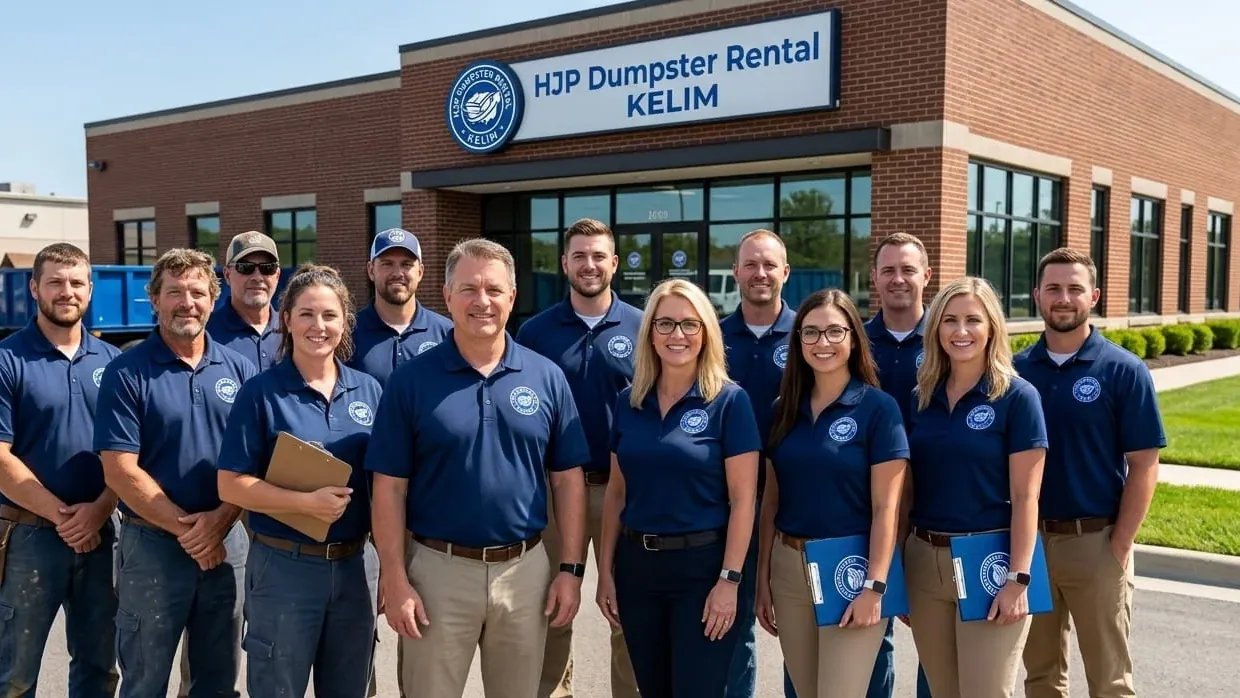
We started HJP Dumpster Rental in 2013 with one truck and one rule: tell people the truth about what it costs and show up when we said we would. 13 years later that has not changed. Hal Prentice still answers the phone most mornings, and our drivers still walk the drop before they back in.
We run out of 832 Kelim Frontage Rd — our yard on the Kelim frontage road, off the I-25 frontage between the Colorado 60 and US 34 interchanges — so we are not routing a truck in from another market when you need a container this afternoon. I-25, US 34, Colorado 60, US 85 and the Larimer and Weld county road grids put every part of this service area inside a comfortable morning. It also means we know whose rulebook your address sits under, and around here that is most of the job. First, there is a county line running through the middle of this town, and it decides who you call. Kelim is an unincorporated community in Larimer County — not Weld, whatever the mailing address suggests — and Johnstown is a home rule town that sits in both counties at once, with the historic Parish Avenue core on the Weld side and the whole I-25 corridor, the 2534 ground, the frontage roads and Kelim on the Larimer side. Five municipalities we serve straddle county lines: Johnstown, Windsor, Berthoud, Erie and Longmont. Two houses a mile apart, same ZIP code, answer to two county governments, two building departments and two road departments, which is why the first thing we ask for is the address. Second, almost nobody here has a collection service that will take this material. The Town of Johnstown provides refuse collection by contract under § 7-61(a) of its municipal code, billed monthly with the water bill under § 7-65(a) and tied to the water tap, and that service does not extend to multifamily buildings of three units or more, or to commercial and industrial customers. Outside the town, neither Weld nor Larimer County collects residential waste at all. Weld County runs two household hazardous waste sites — 1311 North 17th Avenue in Greeley and 5500 Highway 52 in Dacono, (970) 400-2217, free to Weld County residents at 200 pounds per household per visit, and no electronics or appliances — plus a seasonal large-item voucher good for one truckload or a one-ton trailer, one per Weld address. A Kelim address is a Larimer address, so none of that is free to you; Larimer County residents use the Central Diversion and Transfer Station, 2388 W. Trilby Road, Fort Collins, (970) 498-5772. That asymmetry is real, it catches people out, and it is one of the reasons a container exists. Third, where a load can legally go is a county question in Colorado. A landfill here operates on a Certificate of Designation issued by the county under C.R.S. § 30-20-102, with CDPHE review, and the certificate attaches to the disposal site rather than to the truck. Beyond the statewide electronics ban and the waste tire rules there is no single statewide list of what a facility must refuse — each site sets it in its own approved operating plan — which is exactly why we ask what is in the load before we quote it. Fourth, the fire code here does not come from the county. Weld County’s own building ordinance says the International Fire Code “shall apply only when adopted by a local fire district and shall not be enforced under this Building Code,” so on unincorporated ground the authority is the fire district, and for the Johnstown and Milliken area that is Front Range Fire Rescue on 970-587-4464. The Town of Johnstown’s building regulations adopt the 2024 International Fire Code, whose § 304.3.4 and § 304.3.5 both keep a dumpster five feet clear of combustible walls, openings and combustible roof eave lines; every roll-off we own is far over both thresholds, so the working answer never changes — five feet, always. Past the codes it is street knowledge: which frontage-road and county-road approaches will take a 40 and which want a 20 set on plywood; that hail is the anchor job here, with seven to nine hail days a year in what NOAA calls the nation’s most hail-prone corridor; that both counties publish a 30-inch frost line, so basements are ordinary and a clear-out is a vertical stack rather than one room; and which side of the Larimer–Weld line your address falls on.
Read more about who we are and how we got started, or jump straight to what we haul.
- Founded2013
- Container sizes10 – 40 yd³
- Typical deliverySame or next day
- Areas served17+
What we haul
Dumpster rental services in Kelim and Northern Colorado
Eleven container services, one flat-rate promise. Whatever the job, the price we quote on the phone is the price on your invoice.
Residential Dumpster Rental
Driveway placement for the basement, garage and outbuilding cleanouts a northern Colorado house produces.
Learn more →Commercial Dumpster Rental
Containers for businesses and contractors along the I-25 corridor — neither county collects at the curb.
Learn more →Construction Dumpster Rental
Mixed C&D in one roll-off, with next-day swap-outs across Larimer and Weld.
Learn more →Roofing Dumpster Rental
Weight-rated cans sized by squares and layers — hail tear-off is what this market runs on.
Learn more →Roll-Off Dumpster Rental
10, 15, 20, 30 and 40 yard roll-offs across Larimer and Weld counties.
Learn more →Same-Day Dumpster Rental
Call before the cut-off and we can usually get a container to you this afternoon.
Learn more →Junk Removal Dumpsters
Clear a basement, garage, shop or outbuilding on your own schedule.
Learn more →Estate Cleanout Dumpsters
Discreet, patient container service for families clearing a lifelong home.
Learn more →Demolition Debris Removal
Containers and fast swaps for decks, outbuildings, sheds, garages and interior gut-outs.
Learn more →Concrete & Heavy Debris
Dedicated heavy cans for broken slab, block and brick, loaded flat and low.
Learn more →Yard Waste & Brush Removal
Clean separate loads — Colorado has no yard-waste landfill ban, so you have real options.
Learn more →Choose your size
Five sizes, sized for real projects
Not sure which one? Tell us what you are clearing out and roughly how much of it there is. Ninety percent of the time we can size it correctly over the phone in under two minutes. The first question here is what the debris weighs rather than how much room it takes, because broken concrete, block, brick and mortar, a basement floor broken out, a retaining wall pulled, a driveway apron replaced and spoil out of a 30-inch footing trench are all weight jobs long before they are volume jobs. Dense material wants a small can, every time. Roofing is the same conversation, and on this corridor it is the one we have most often: a hail tear-off is counted in squares and layers, it reaches lawful payload while the box still looks half empty, and it never goes in a 30 or a 40. The job that genuinely wants a 30 or a 40 is the opposite — a basement and a garage cleared to the walls, or a multi-room remodel of furniture, cabinets, carpet, insulation and trim — because that debris takes enormous space and weighs comparatively little. In between sits the 20, which is the default around here. Two local numbers change the math. Both counties publish a 30-inch frost line, so houses here have a downstairs and the ordinary clear-out is a vertical one. And this is semi-arid country — the Greeley–Weld County Airport 1991–2020 normal is about 15.34 inches of precipitation a year — so the risk to an open container is not a soaked load, it is wind. An open box is a sail, chinook downslope windstorms are a real event on this side of the Front Range, and Weld County publishes a 115 mph basic residential wind speed. Keep the load below the rails and tarp it.
10 Yard Dumpster
Broken slab, block, brick and dirt — the box that reaches payload long before it looks full.
View this size → 15yd³15 Yard Dumpster
The workhorse for an ordinary single-layer hail tear-off, or one room cleared to the walls.
View this size → 20yd³20 Yard Dumpster
A whole-house declutter — the default here — a large roof, or a multi-room remodel.
View this size → 30yd³30 Yard Dumpster
A large remodel, a basement strip-out or a full estate cleanout. Never roofing.
View this size → 40yd³40 Yard Dumpster
Commercial gut jobs and construction — it needs the most room to set down.
View this size →How it works
Four steps, no paperwork
- 1
Call us
Tell us the project, your address and when you want it. Two minutes on the phone and you have a flat price.
- 2
We deliver
Our driver walks the drop, lays protection boards and sets the container exactly where you want it.
- 3
You load it
Take your time within your rental window. Keep it level with the top rail and we handle the rest.
- 4
We haul it
Call or text when you are done. We pull it, sort what can be recovered and dispose of the rest properly.
Local knowledge
What makes hauling in Kelim different
Ground, wind, and a line that decides which desk answers
Placement is where most of the trouble starts, and here it starts with the surface. Kelim sits at 4,938 feet on flat irrigated high plains — nearly a mile up, but farm country at the foot of the range rather than mountains, so our approaches are section-line county roads and interstate frontage rather than switchbacks. We will not tell you what the ground does at depth under your driveway, because that is a geotechnical question and nobody has surveyed it. What we deal with is surface behavior, and it has three states here. Dry, it carries a loaded container as well as anything in the country. Soft — after irrigation, after snowmelt, after one of the cloudbursts that deliver much of the year’s water in a few days — and several tons on four small contact patches will cut in and stay cut in. Frozen, it carries fine until the thaw. So a lawn, a verge or a soft gravel pad is not a load-bearing surface: plywood or timber mats go under the wheels and both rails, the box goes on the driveway rather than the grass, and occasionally a smaller box gets loaded flat and low instead. Figure on roughly 60 ft of straight approach, 11 ft of width and 20+ ft of clear sky for the hoist arm, plus room for the basement walkout, the meter and the service drop. Wind is the other ground condition, and it is the governing weather risk here. Front Range downslope chinook windstorms have produced recorded gusts of 137 mph, Weld County publishes a 115 mph basic residential wind speed and Larimer County publishes site-specific speeds from 115 to 225 mph — a county does not publish numbers like that unless wind is a first-order structural concern. An empty container walks and a heaped one empties itself down the street. Tarp it, weight it, and load below the rails.
Then the rules a national guide gets wrong for this address. On private property — a driveway, a yard, a parking lot — no right-of-way permit is in play at all, and that covers the overwhelming majority of the placements we make. The moment any part of the container touches public ground, the address decides the desk. Inside the Town of Johnstown the code is explicit: § 7-35 provides that “no person shall place, store or maintain a dumpster on any public property unless expressly authorized in writing by the Town,” and placement in violation “is considered a nuisance.” Work of any kind in the public right-of-way needs a Town right-of-way permit under § 11-23, with a fee set by resolution of the Town Council under § 11-25 — that figure lives in the Town fee schedule, we could not verify it, and we will not publish a number we cannot stand behind. The Town is at 450 S. Parish Avenue on 970-587-4664. On a county road the question splits with the county line: Weld County Public Works on (970) 400-4000 permits construction activity and “occupation” within county rights-of-way, though its published material does not name containers, and Larimer County Engineering on (970) 498-5709 issues right-of-way and access permits whose published material does not address containers at all. We make no claim in either direction on either county — we give you the number and you ask. And Johnstown’s rules are Johnstown’s; Berthoud, Windsor, Milliken and the rest each answer for themselves. Before anything gets dug for a footing, a fence line, a stump or a service, call Colorado 811 on 811 or 800-922-1987. The statute at C.R.S. Title 9, Article 1.5 requires notice at least two business days ahead, not counting the day of notice, and Colorado 811’s own homepage advises allowing three. White-line the dig area first. Setting a container down is not excavation; digging to make room for one is. Read the permit and placement guide, or the county line guide.
A boom town on a county line, and houses with a downstairs
Johnstown was founded in 1902 by Harvey Parish on ground he had homesteaded between the Big Thompson and the Little Thompson, and incorporated in 1907. It grew on sugar beets and dairy — the Great Western Sugar Company’s “barium sugar plant, the only one of its kind in the world,” in Weld County’s own official history, and the Mohawk and later Carnation condensed milk works — and it still runs BBQ Day every June, descended from the Dairy Day the town started in 1912. Kelim is quieter and much smaller: an unincorporated community named for an early settler, Lee J. Kelim, with a post office that ran from 1915 to 1925 and no government of its own. What has changed is the pace. The Census Bureau put Johnstown at 17,303 in the 2020 census and 22,433 by the July 2025 estimate — up 29.5 percent, and ranked it the tenth fastest-growing town in America for 2024–25. The town issued 528 single-family permits in 2025. New-construction cleanup is not an afterthought in a market like that; it is a service line. So is the other half of the picture: the median Johnstown home was built in 2007, and 71.8 percent of the stock went up in 2000 or later, with only about one home in ten predating 1980. That concentrates the old-house problems — lead paint and asbestos — in the historic Parish Avenue core rather than spreading them across the market, which is the opposite of what a Southeastern instinct expects. And these houses have a downstairs. Weld County’s design criteria and Larimer County’s structural information both publish a 30-inch minimum frost depth. Where footings, water services and sewer laterals go 30 inches down anyway, the marginal cost of a basement is small, and basements are ordinary here as a result. The clear-out that matters is therefore the basement and the garage, and both mean carrying material up or across before it reaches the container — an argument for a 15 or a 20 near the walkout rather than a 30 parked at the road. See our notes on basement and crawlspace cleanouts and the home cleanout checklist.
Weather is the other thing outsiders get wrong about this address. Nothing here is calibrated for rain: the Greeley–Weld County Airport 1991–2020 normal is 15.34 inches of precipitation a year, and the average last spring frost at Greeley is 12 May, so yard work, landscaping and outdoor demolition all start in May rather than March. What we get instead is hail. NOAA’s Colorado climate summary puts northeastern Colorado at seven to nine hail days a year, inside the nation’s most hail-prone corridor, and that makes roof tear-off the anchor job on this corridor — arriving in bursts, a subdivision at a time, in the fortnight after a storm. Then wind, then tornadoes: Weld County has recorded more tornadoes than any other county in the United States, most of them short-lived landspouts along the Denver convergence zone, and the 2008 Windsor tornado destroyed 78 homes about five and a half miles from Kelim. And water arrives all at once when it arrives: in September 2013 the Big Thompson, the Little Thompson and the South Platte cut Colorado 60 and, in the Colorado Department of Transportation’s own words, left “the Town of Milliken and portions of Johnstown completely isolated.” The forecast office is NWS Denver/Boulder on 303-494-3210. Two rules decide what a renovation container is legally carrying. Asbestos is an air quality matter in Colorado, under CDPHE’s Air Pollution Control Division and Regulation 8, Part B: in a single-family home the trigger is 32 square feet or 50 linear feet, a certified inspection comes first, notification runs ten working days ahead, any demolition requires notification regardless of size, and the published single-family fees are $60 for a notice and $180 for a thirty-day permit. The number is 720-507-5136. We do not accept asbestos in our containers, ever. Lead is the federal Renovation, Repair and Painting rule for pre-1978 housing, and here is the reversal that catches contractors moving in from the Southeast: Colorado is not an EPA-authorized state, so firms certify with EPA directly rather than through a state program.
How Colorado actually handles disposal, and what cannot go in the box
Colorado’s solid waste rules sit with CDPHE at 6 CCR 1007-2, and the structure is genuinely different from the Southeast. There is no single statewide list of what a landfill must refuse. Beyond the statutory bans, each facility’s accepted and prohibited materials are set in its own approved operating plan, which is why we ask what is in a load rather than reciting a state list. Above that sits the Certificate of Designation: under C.R.S. § 30-20-102 a person who owns or operates a solid wastes disposal site and facility must first obtain a certificate from the governing body with jurisdiction — the county — with CDPHE review. That certificate attaches to the disposal site, not to a hauler and not to a truck. What is banned outright is narrow, and worth knowing by name. Electronics have been banned from Colorado landfills since 1 July 2013 under C.R.S. § 25-17-303, and the landfills serving this corridor all list electronic waste as prohibited at the gate. Waste tires are heavily restricted under 6 CCR 1007-2, Section 10 — no person may transport ten or more waste tires without CDPHE registration — and the local landfills refuse them outright in any case. Tires never ride with us. And here is the reversal that trips up anyone arriving from a Southeastern market: Colorado has no statewide yard-waste landfill ban. The landfills serving this area publish yard waste and tree branches among the materials they accept. That does not mean brush should ride in the corner of a mixed remodel box — there are three permitted composting facilities in Weld County alone, A-1 Organics is on 970-454-3492, and a clean green load has a better route and a cheaper one. It means the reason is sorting and economics rather than a statute, and we would rather tell you that than repeat a rule that belongs to another state.
Locally the picture closes in from three directions. The Town of Johnstown’s collection is by contract under § 7-61(a), billed with the water bill under § 7-65(a) and tied to the water tap, and it does not serve multifamily buildings of three or more units or commercial and industrial customers. Neither county collects residential waste. Weld County runs household hazardous waste sites at 1311 North 17th Avenue in Greeley and 5500 Highway 52 in Dacono, (970) 400-2217, free to Weld residents at 200 pounds per household per visit, with nothing over five gallons, nothing leaking, nothing in plastic bags — and no electronics and no appliances — plus a seasonal voucher good for one truckload or a one-ton trailer, one per Weld address. Larimer County residents, which is what a Kelim address makes you, use the Central Diversion and Transfer Station, 2388 W. Trilby Road, Fort Collins, (970) 498-5772, with a 24-hour closure line on (970) 498-5770. And burning is not the shortcut it looks like in farm country: open burning is restricted by the fire district under the fire code’s Chapter 3 provisions, and the categories that are allowed at all need a permit — a question for Front Range Fire Rescue on 970-587-4464 rather than for us, because Weld County enforces no fire code of its own. One more operational fact worth more than most advice on this page: Front Range Landfill states that all uncovered or unsecured loads are charged double. That is why the tarp goes on before the truck leaves your driveway. Full detail in the Colorado disposal and recycling rules.
Weight at one end, the scale ticket at the other
Broken concrete, block, brick and mortar are the heaviest material we carry. We have no published table to point you at for this one, so take it as a rule of thumb off our own scale tickets rather than a sourced figure: somewhere around 2,400–2,800 lbs per cubic yard. The point holds whatever the exact number is — a heavy load reaches lawful transport weight in a container that still looks half empty. That material belongs in a 10 yard, twice, rather than a 30 once — see concrete and heavy debris. The local versions are a basement floor broken out, a foundation repair, a driveway apron replaced, a retaining wall pulled and old footings dug up. There is a Colorado wrinkle on top of the weight, and it is the frost line: both counties publish 30 inches, so footings, water services and sewer laterals here start deeper than a Southeastern customer expects, and a trench produces correspondingly more spoil. Dug ground does not settle and does not compress; a couple of yards of it will do more to the scale ticket than a room full of cabinets. The other weight job is the roof, and on this corridor it is the main event. Tear-off is counted in squares and layers, never in roof area, and it is common to find a second course still on the deck. Shingle is dense, so a hail tear-off runs out of payload long before it runs out of room — which is why roofing never goes in a 30 or a 40 here. See roofing dumpsters and the hail tear-off guide.
The other half of the job is what happens to the load afterwards, and here it is sorting rather than a statute that decides the bill. Colorado has no statewide yard-waste ban — the landfills serving this corridor accept yard waste and tree branches — but a clean green load still travels better and cheaper on its own, and there is composting capacity within twenty miles of the yard. Clean corrugated cardboard and scrap metal come out of the box first: both have a market and neither needs paying for by the ton. Electronics come out because they are unlawful to landfill in Colorado under C.R.S. § 25-17-303, and Weld County’s household hazardous waste sites will not take them either, so they need a recycler. Tires come out because the landfills refuse them. Then load heavy over light, keep everything below the top rail where it can be covered, and bag the insulation before the wind finds it — in a market with a 115 mph design wind and recorded chinook gusts of 137 mph, an open, heaped, unsecured container is a genuine liability rather than an untidy one. See yard waste removal, the yard waste and brush guide and the construction debris disposal guide.
- 13+Years serving Larimer County
- 17Communities and neighborhoods served
- 13In-depth local guides published
- 5Container sizes, 10 to 40 yard
What customers say
Straight talk from Kelim and Northern Colorado
Hal was the only one who asked which side of the county line the house was on before he quoted, and it turned out to matter. He put the box on boards so the drive never marked, and it was there at seven like he said.
Hail took the whole roof and every outfit in the county was booked. HJP had a 15 on the drive the next morning, swapped it once, and told us plainly that a 30 would have been the wrong box for shingle. He was right.
We are out on unincorporated ground with no town to call, and he knew exactly who the fire district was and what the setback had to be. Nobody else could answer that. The container never moved in the wind either.
My mother had been in the same house since 1979 and we had a month. They set a 20, swapped it twice, and never once made us feel rushed. The driver told us what could not ride and where it had to go instead.
Reviews are shown as supplied by customers. Ratings and counts shown elsewhere on this site are illustrative pending live review syndication.
Service area
Dumpster delivery across Larimer and Weld counties
We deliver daily from our yard on the Kelim frontage road. Pick your area for local placement notes, the jurisdiction answer, landmarks and permit guidance — or see the full service area.
Dumpster Rental FAQs
How fast can you deliver a dumpster in Kelim?
Most of the time, same day if you call before nine, and next morning otherwise. We run our own trucks out of 832 Kelim Frontage Rd, straight onto the I-25 frontage, so we are not waiting on a dispatcher in another state. The predictable rushes here are worth planning around, and they are not the ones a Southeastern calendar would predict. Hail is the big one — northeastern Colorado averages seven to nine hail days a year, and a single storm can put a whole subdivision of roofs into replacement inside a fortnight. Spring starts late: the average last frost at Greeley is 12 May, so yard work, landscaping and outdoor demolition all bunch into May rather than March. Winter takes days out of the routing rather than out of the calendar, because snow and ice on a sloping driveway changes where a box can safely be set and pulled. And in a town that issued 528 single-family permits in 2025, construction cleanup runs all year. Drive time matters more than the address: a run down to Erie or Longmont at the far southwest end is a different morning from a set on the frontage road. If you know your dates, book ahead and we will hold the slot.
What does a flat rate actually include?
Delivery, pickup, an agreed rental period and a set tonnage allowance with disposal included. No fuel surcharge, no environmental fee, no admin fee. The only way the number changes is if you go over the weight allowance or keep the container longer than agreed, and we tell you both limits before we deliver.
Do I need to be home for delivery or pickup?
No. Plenty of our customers text us a photo of where they want it and go to work. All we need is clear access, a spot free of cars and low branches, and permission to be on the property. If the only way in is a narrow drive, a long approach down to a basement walkout, a gravel pad, or a turn tight enough that the truck has to swing wide, tell us when you book and we will schedule accordingly. Mention anything soft underfoot in particular — irrigated ground, a spring thaw and soft gravel will each hold a loaded truck for about as long as it takes to regret it. If the property is on its own well and septic, tell us where the tank, the drain field and the well head are so the box does not go over any of them. If it is in a homeowners association, say so on the first call, because the association rules govern placement there and it is easier squared away before we roll than after. And say so if the building is empty — on an unattended job the risk here is wind rather than rain, so we will talk you through keeping the load below the rails where it can be tarped and weighted.
Will the dumpster damage my driveway?
We put protection boards under the wheels and rails on every residential delivery, which spreads the load instead of concentrating it on four small contact patches. We will not tell you what the ground does at depth under your slab — that is a geotechnical question, nobody has surveyed your driveway, and anyone answering it off a website is guessing. What we deal with is the surface, and the surface here has three states. Dry, and it carries a loaded container as well as anything in the country. Soft — after irrigation, after a spring thaw, after one of the cloudbursts that deliver much of the year’s water in a few days — and several tons on four small contact points will cut in and stay cut in. Frozen, and it carries fine right up until it does not. A loaded 20 yard container is several tons; the driveway is the right answer and the lawn is not. We photograph the existing condition on delivery either way. Older or hairline-cracked concrete gets extra boards, and so does newer flatwork, which settles under a point load rather than scuffing. On a gravel pad we are fine while it is dry, but for a day or two after heavy water we would rather come back than cut ruts into it. Our placement guide explains it fully.
Do I need a permit for a dumpster in Kelim?
On your own driveway or your own property, no right-of-way permit is in play at all, and that covers the overwhelming majority of the containers we set. What changes the answer is public ground, and then the address decides the desk. Inside the Town of Johnstown, § 7-35 of the municipal code provides that “no person shall place, store or maintain a dumpster on any public property unless expressly authorized in writing by the Town,” and placement in violation “is considered a nuisance.” Any work in the public right-of-way needs a Town right-of-way permit under § 11-23, and the fee for it is set by resolution of the Town Council under § 11-25 — it lives in the fee schedule, we could not verify it, so we do not publish a number. Call the Town at 970-587-4664 before delivery rather than after. On a county road the county line decides. Weld County Public Works, (970) 400-4000, permits construction activity and occupation within county rights-of-way, but its published material does not name dumpsters, so we do not claim it covers them — the language is broad and a call is warranted. Larimer County Engineering, (970) 498-5709, issues right-of-way and access permits whose published material does not address containers at all, so we claim nothing in either direction there either. And Johnstown’s rules are Johnstown’s. Berthoud, Windsor, Milliken, Mead, Greeley, Evans and the rest each run their own counter, and we have not verified what any of them require of a container — ask the town, and we will tell you which town you are in. On the fire side, the Town of Johnstown’s building regulations adopt the 2024 International Fire Code. Its § 304.3.5 keeps a dumpster of 1.5 cubic yards or more, and § 304.3.4 a dumpster of 1.0 cubic yard or more that is not of noncombustible construction, five feet clear of combustible walls, openings and combustible roof eave lines. Every roll-off we run is far over both, so the answer is stable: five feet, always. Note that Weld County enforces no fire code of its own — its ordinance says the International Fire Code applies only when adopted by a local fire district — so on unincorporated ground that question goes to the district, which for the Johnstown and Milliken area is Front Range Fire Rescue on 970-587-4464. Before anything gets dug, call Colorado 811 on 811 or 800-922-1987: C.R.S. Title 9, Article 1.5 sets notice at no less than two business days, not counting the day of notice, Colorado 811 advises allowing three, and you white-line the dig area first. Requirements and fees change, so confirm with the desk before you book — or read our permit and placement guide.
What can I not put in the dumpster?
Wet paint, solvents, adhesives, motor oil, fuel, tar, pesticides, pool chemicals, automotive fluids, asbestos-containing material, propane and other pressurized cylinders, batteries, medical waste and refrigerant appliances. Three Colorado rules are worth knowing by name, and two of them run the opposite way from the Southeast. Electronics are banned from Colorado landfills outright, and have been since 1 July 2013 under C.R.S. § 25-17-303 — televisions, monitors, computers and the rest need a recycler, and Weld County’s household hazardous waste sites do not take them either. Waste tires are restricted under 6 CCR 1007-2, Section 10, no person may transport ten or more without CDPHE registration, and the landfills serving this corridor refuse them at the gate regardless. Tires never ride with us. And yard waste is not banned in Colorado — there is no statewide landfill ban, and the local landfills publish yard waste and tree branches among accepted materials — so if you have read elsewhere that brush cannot go in a container, that rule belongs to another state. We still run it as a clean separate load, because composting is close by and cheaper, not because a statute says so. Batteries, liquids, hazardous material and refrigerant appliances go to Weld County household hazardous waste on (970) 400-2217 if you are a Weld resident, and to Larimer County’s Central Diversion and Transfer Station on (970) 498-5772 if your address is on the Larimer side, as a Kelim address is. Asbestos never rides with us either: in Colorado that is an air quality matter under CDPHE Regulation 8, Part B, with a 32 square foot or 50 linear foot trigger in a single-family home, a certified inspection first, ten working days’ notice, and notification required for any demolition regardless of size; the number is 720-507-5136. Everything else on a normal cleanout or renovation is fine. Rules do change, so ask us before it goes in.
Still not sure?
Two minutes on the phone beats twenty minutes reading. Tell us the job and we will size it, price it and book it.
(970) 427-0341Helpful Local Resources
Useful official sources for permits, disposal rules and recycling in Kelim and Larimer County. We keep these handy because half the questions we get are really questions for one of these offices.
- Town of JohnstownRefuse collection by contract, the right-of-way permit desk, and the town that sits in two counties at once.
- Johnstown Municipal Code§ 7-35 on dumpsters, § 7-61 on town refuse collection and § 11-23 on work in the public right-of-way.
- Weld CountyNo residential collection at all — household hazardous waste sites, the seasonal disposal voucher, and right-of-way permits.
- Larimer CountyThe county Kelim is actually in — the Central Diversion and Transfer Station, engineering permits and adopted building codes.
- Front Range Fire RescueThe fire district covering Johnstown and Milliken. Weld County enforces no fire code of its own, and on the Larimer side we did not establish the county’s position — either way the district is the desk to ask about container placement.
- Colorado 811Free utility locates before you dig — two business days by statute, and white-line the dig area first.
- CDPHESolid waste under 6 CCR 1007-2, and asbestos as an air quality matter under Regulation 8, Part B.
- US EPAThe Renovation, Repair and Painting rule — Colorado is not an authorized state, so certification runs through EPA directly.
- Town of MillikenThe Weld County town east of the interstate, with its own code and its own answers.
- Town of WindsorAnother town that straddles the Weld and Larimer line, with its own permit counter.
- Town of BerthoudA statutory town spanning Larimer and Weld, south-west of us.
- City of GreeleyThe Weld County seat, and its own municipal rules.
- National Weather ServiceForecasts, warnings and hail reports for Larimer and Weld, from the Denver/Boulder office.
- Colorado Geological SurveyGround conditions along the northern Front Range.
Talk to a real person
Need a dumpster in Kelim today?
Tell us what you are clearing out and we will tell you the right size and the flat price to put it in your driveway. No forms, no waiting on an email — just call and we will sort it out in a couple of minutes.
Serving Kelim, Larimer County and Northern Colorado · Mon–Fri 6:30am–5pm, Sat 7am–1pm